Is ChatGPT Better Than Google in 2026? The Real Answer Is ?
Discover which AI-powered platform works best for your daily needs: real-time search or conversational intelligence
In 2026, choosing between Google Search and ChatGPT isn’t about picking winners and losers—it’s about understanding which tool solves your specific problem. Both platforms have evolved dramatically, but they serve fundamentally different purposes in your digital life.
This guide cuts through the noise to help you make smart choices. Whether you’re researching for work, learning something new, or just trying to find the best coffee shop nearby, you’ll know exactly which tool to reach for.
The 30-Second Decision: Which Tool Should You Use Right Now?
Need an answer fast? Here’s your instant decision guide:
| Use Case | Google Search | ChatGPT |
|---|---|---|
| Real-Time & Local Info | Breaking news, stock prices, sports scores, weather, local businesses, directions, “near me” searches | Not ideal – ChatGPT does not provide real-time data |
| Research & Citations | Academic research, authoritative sources, product reviews, shopping comparisons | Good for conceptual understanding, summarizing, or brainstorming, but not formal citations |
| Content Creation | Limited – mostly links and references | Emails, reports, creative writing, coding assistance, brainstorming, step-by-step tutorials, learning guidance |
| Information Summarization | Requires scanning multiple sources manually | Excellent for summarizing, synthesizing multiple concepts, and providing explanations in plain language |
What’s Different in 2026? The Latest AI Developments
The AI landscape has transformed significantly since 2025. Here’s what matters:
Google’s Evolution
Google has doubled down on its AI Overviews feature, which now appears for over 60% of searches in the US. These AI-generated summaries sit at the top of search results, giving you quick answers while still providing links to source websites. The integration is more seamless than ever, with real-time fact-checking and citation trails built directly into results.
The search giant has also expanded its multimodal capabilities—you can now search using images, voice, and text simultaneously through Google Lens, making visual search more powerful than ever for identifying products, plants, landmarks, and even homework problems.
ChatGPT’s Breakthrough Features
ChatGPT in 2026 has web browsing capabilities in both free and paid tiers, addressing its biggest limitation. It can now access current information, verify facts in real-time, and provide citations from recent sources. However, this feature works differently than Google—it’s more selective and conversational rather than comprehensive.
The introduction of memory features means ChatGPT remembers your preferences, past conversations, and context across sessions. This makes it significantly more personalized than Google’s search experience.
Voice mode has become remarkably natural, enabling genuine back-and-forth conversations that feel more like talking to a knowledgeable friend than querying a machine.
Real-World Scenarios: Making the Right Choice
| Scenario | Best Approach | How to Use ChatGPT | How to Use Google |
|---|---|---|---|
| Writing a Research Paper | Start with ChatGPT, verify with Google | Understand complex theories, outline arguments, simplify concepts | Find peer-reviewed sources, verify claims, gather proper citations |
| Planning a Weekend Trip | Google dominates here | Suggest general trip ideas and activity options | Real-time reviews, maps, current hours, visitor photos, parking info |
| Learning to Code | ChatGPT leads, Google supports | Write code examples, explain errors, provide step-by-step guidance | Official documentation, library references, developer forum troubleshooting |
| Checking Today’s News | Google for breaking news, ChatGPT for context | Understand background, explain significance, connect trends | Latest headlines and real-time news from multiple sources |
Deep Dive: Why Each Platform Excels
Google’s Unbeatable Advantages
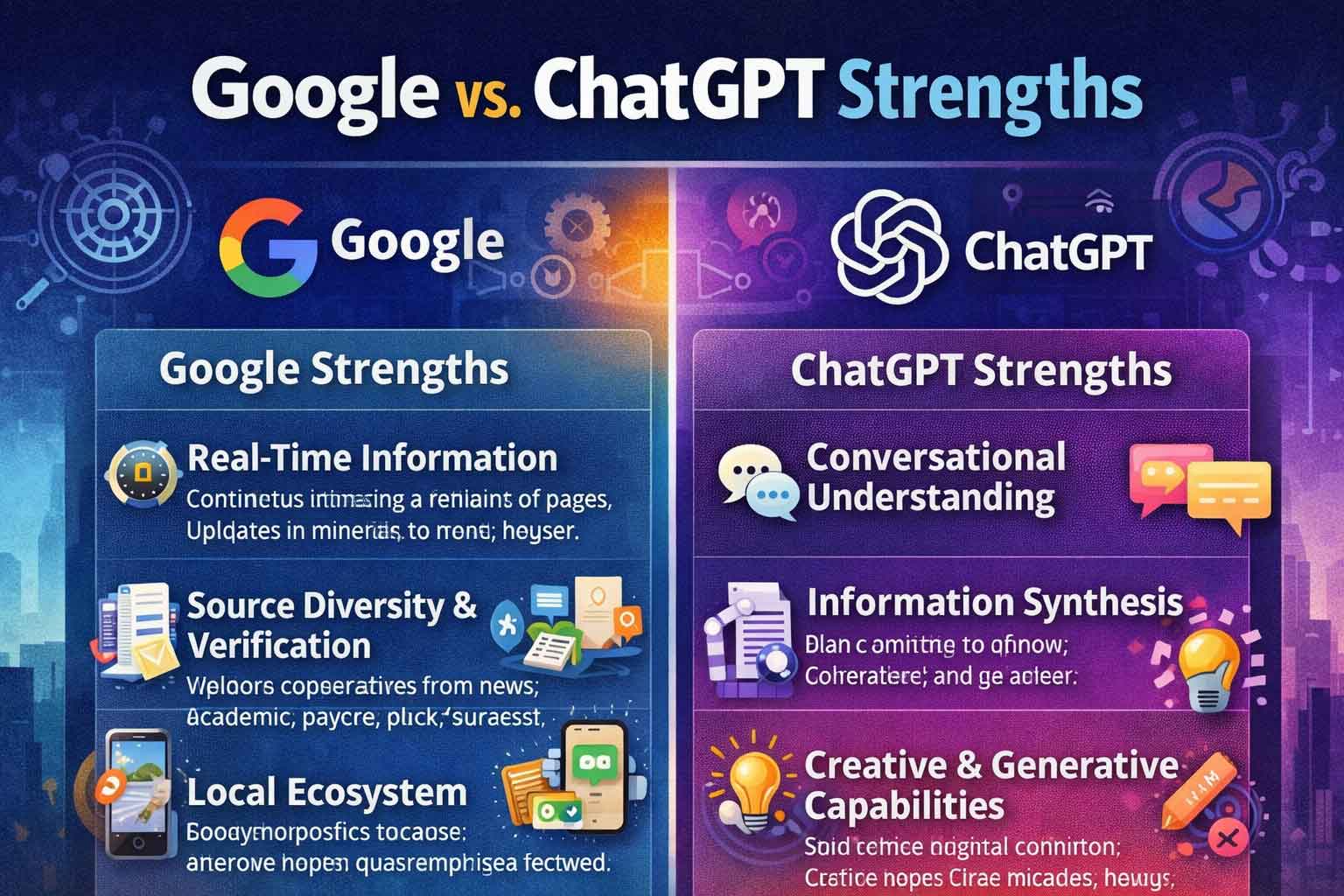
| Feature | Google Strengths | ChatGPT Strengths |
|---|---|---|
| Real-Time Information | Continuous indexing of billions of pages. Updates in minutes for news, hours for local changes. Unmatched real-time capability. | Not real-time; provides context, explanations, and guidance based on existing knowledge. |
| Source Diversity & Verification | Multiple perspectives from news, academic papers, government, blogs. Ideal for fact-checking and forming balanced opinions. | Synthesizes information from multiple sources into coherent explanations. Highlights patterns, connections, and formatted outputs. |
| Local Search & Ecosystem | Google Maps + Search + Business integration. Real-time traffic, updated hours, customer photos, review trends, booking links. | Not location-specific; cannot provide real-time local updates. |
| Conversational Understanding | Requires precise search queries and keywords; little conversation flow. | Maintains context and conversational flow. Can refine answers iteratively, reducing friction compared to search queries. |
| Creative & Generative Capabilities | Retrieves existing information; cannot generate new content. | Generates original content—emails, code snippets, creative stories, outlines—and refines through conversation. |
Know the Limitations: When Each Tool Falls Short
Where Google Struggles
Information Overload
Google often gives you too much. For simple questions, you’re faced with pages of results, SEO-optimized content that may not directly answer your question, and the need to evaluate source credibility yourself. The abundance of information can become overwhelming.
Fragmented Experience
Getting a complete answer often requires clicking through multiple websites, each with different designs, ads, and paywalls. You become responsible for synthesizing information across sources, which takes time and mental energy.
Where ChatGPT Falls Short
Accuracy Concerns
ChatGPT can confidently state incorrect information. These “hallucinations” happen because it generates responses based on patterns rather than retrieving verified facts from a database. For critical decisions—medical advice, legal questions, financial planning—always verify ChatGPT’s responses with authoritative sources.
No True Real-Time Data
Even with web browsing enabled, ChatGPT’s approach to current information is selective and conversational rather than comprehensive. It’s not designed to scan hundreds of sources or provide real-time financial data. For live scores, breaking news, or time-sensitive information, Google remains superior.
Limited Multimedia Access
ChatGPT can’t show you maps, play videos, or display product galleries the way Google can. For visual information—whether you’re shopping, planning travel, or learning through video tutorials—Google’s multimedia capabilities are essential.
The Smart Strategy: Using Both Tools Together
The most effective users don’t choose between Google and ChatGPT—they use both strategically. Here’s how to combine their strengths:
The Research Workflow
- Start with ChatGPT to understand the topic, learn key concepts, and identify what questions to ask
- Move to Google to find authoritative sources, current data, and diverse perspectives
- Return to ChatGPT to synthesize findings, identify patterns, and draft your final output
The Fact-Checking Principle
Use ChatGPT for explanations and understanding, but verify important facts with Google. If ChatGPT makes a specific claim about statistics, dates, or current events, cross-reference it with authoritative sources. This combination gives you the best of both worlds: clarity and accuracy.
What’s Next: The Future of AI Search in 2026 and Beyond
The distinction between search engines and conversational AI continues to blur. Google is incorporating more AI-generated summaries and conversational features, while ChatGPT gains better access to real-time information. The future likely involves:
- Unified experiences that seamlessly blend traditional search with conversational AI
- Personalization at scale with AI understanding your preferences, expertise level, and context
- Multimodal everything where you search and receive answers through text, voice, images, and video interchangeably
- Specialized AI assistants optimized for specific domains like healthcare, legal research, or education
Quick Tips for Maximum Effectiveness
Getting the Most from Google
- Use specific, descriptive search terms rather than full questions
- Check the date on articles for time-sensitive topics
- Use Google Scholar for academic research instead of regular search
- Evaluate source credibility—government sites, educational institutions, and established media tend to be more reliable
Getting the Most from ChatGPT
- Be conversational—explain your needs like you’re talking to a knowledgeable colleague
- Ask follow-up questions to refine answers rather than starting over
- Request specific formats (“explain like I’m 10” or “give me a professional summary”)
- Always verify important facts with authoritative sources
Final Takeaway: It’s Not Either/Or
In 2026, the question isn’t whether Google or ChatGPT is better—it’s about knowing which tool to reach for in each moment. Google remains unbeatable for real-time information, local search, and accessing diverse sources. ChatGPT excels at explanation, conversation, and creative work.
Master both platforms, understand their strengths and limitations, and develop personal workflows that leverage each tool strategically. The future belongs to users who can fluently move between traditional search and conversational AI, using whichever approach best serves their immediate needs.
Start experimenting today. Try ChatGPT for your next learning session, use Google for your next research project, and notice which tool feels natural for different tasks. Over time, you’ll develop intuition for when to use each platform—and that’s when you’ll become truly effective at navigating the modern information landscape.
Google vs ChatGPT 2026
1. Is ChatGPT better than Google in 2026?
Neither is universally “better”—they serve different purposes. Google Search excels at real-time information, local searches, and accessing diverse sources across the web. ChatGPT is superior for explaining complex topics, creative writing, and conversational problem-solving. In 2026, the smartest approach is using both tools strategically based on your specific task.
Best for Google: Breaking news, local businesses, shopping, real-time data Best for ChatGPT: Learning, writing, brainstorming, step-by-step guidance
2. Can ChatGPT replace Google Search?
No, ChatGPT cannot fully replace Google Search. While ChatGPT has gained web browsing capabilities in 2026, it still lacks Google’s real-time information access, local search integration with Google Maps, comprehensive source diversity, and multimedia search features. ChatGPT works best as a complement to Google, not a replacement.
What ChatGPT Can’t Do:
- Provide live sports scores or stock prices
- Show nearby restaurants with maps and reviews
- Display product comparisons from multiple retailers
- Access breaking news from hundreds of sources simultaneously
3. Which is more accurate: Google or ChatGPT?
Google is more reliable for factual accuracy because it links directly to authoritative sources you can verify. ChatGPT can generate plausible but incorrect information (called “hallucinations”) since it creates responses based on patterns rather than retrieving verified facts. For critical decisions—medical, legal, or financial matters—always verify ChatGPT’s answers with authoritative sources found through Google.
Accuracy Best Practice: Use ChatGPT for understanding and explanations, then verify important facts with Google-sourced authoritative websites.
4. Does ChatGPT have access to real-time information in 2026?
Yes, but with limitations. ChatGPT in 2026 has web browsing capabilities that allow it to access current information selectively. However, this differs from Google’s comprehensive real-time indexing. ChatGPT’s web access is conversational and selective rather than exhaustive. For time-sensitive data like financial markets, weather, or breaking news, Google remains more reliable and comprehensive.
When to use Google for real-time info: Stock prices, weather, sports scores, traffic, breaking news, current business hours
5. Which is better for students: Google or ChatGPT?
Students benefit most from using both tools strategically. Use ChatGPT to understand complex concepts, get explanations in simple terms, and help with writing. Use Google Scholar for finding peer-reviewed sources, accessing academic papers, and gathering properly cited references for research papers. ChatGPT cannot replace the need for authoritative academic sources that Google provides.
Student Workflow:
- ChatGPT: Understand the topic and key concepts
- Google Scholar: Find authoritative academic sources
- ChatGPT: Help organize research and improve writing
- Google: Verify all facts and citations
6. Is ChatGPT free or do I need to pay?
ChatGPT offers both free and paid versions in 2026. The free version provides basic capabilities with some limitations during peak times. ChatGPT Plus (paid subscription) offers faster responses, access to advanced models, priority during high traffic, and additional features like extended memory. Google Search remains completely free for all users, supported by advertising.
Cost Comparison:
- Google Search: Free
- ChatGPT Free: Basic features, some limitations
- ChatGPT Plus: ~$20/month, advanced features
7. Which is better for research and writing papers?
Use both strategically. Start with ChatGPT to understand complex theories and outline your argument. Then switch to Google Scholar to find peer-reviewed sources and verify claims. Finally, return to ChatGPT to help synthesize findings and improve your writing. Google is essential for proper academic citations, while ChatGPT excels at explanation and writing assistance.
Research Paper Process:
- ChatGPT: Initial understanding + outlining
- Google Scholar: Finding credible sources + citations
- ChatGPT: Summarizing research + writing assistance
- Google: Final fact-checking and verification
8. Can ChatGPT help me find local restaurants and businesses?
No, ChatGPT lacks local search capabilities. It cannot access Google Maps, show nearby businesses with real-time reviews, display current operating hours, or provide directions. For any location-based query—finding restaurants, shops, services, or navigation—Google Search with Google Maps integration is essential and far superior to ChatGPT.
Local Search Winner: Google Search dominates completely for anything “near me” or location-specific.
9. Which AI tool is better for coding and programming?
ChatGPT is generally better for coding assistance. It can write code snippets, explain programming concepts interactively, debug errors, and provide step-by-step guidance adapted to your skill level. However, Google remains valuable for accessing official documentation, finding specific error solutions in developer forums, and exploring library-specific resources.
Coding Use Case:
- ChatGPT: Interactive learning, code generation, debugging explanations
- Google: Official documentation, Stack Overflow solutions, library references
10. Will AI search tools like ChatGPT replace Google in the future?
Instead of replacement, expect integration. Both Google and ChatGPT are evolving toward hybrid models that combine traditional search with conversational AI. Google is adding AI-generated summaries and conversational features, while ChatGPT is gaining better web access. The future likely involves unified tools that seamlessly blend both approaches, automatically selecting the best method for each query type.
The best AI tool is the one that gets you the answer you need, when you need it, in the format that works for you. Now you know how to choose.