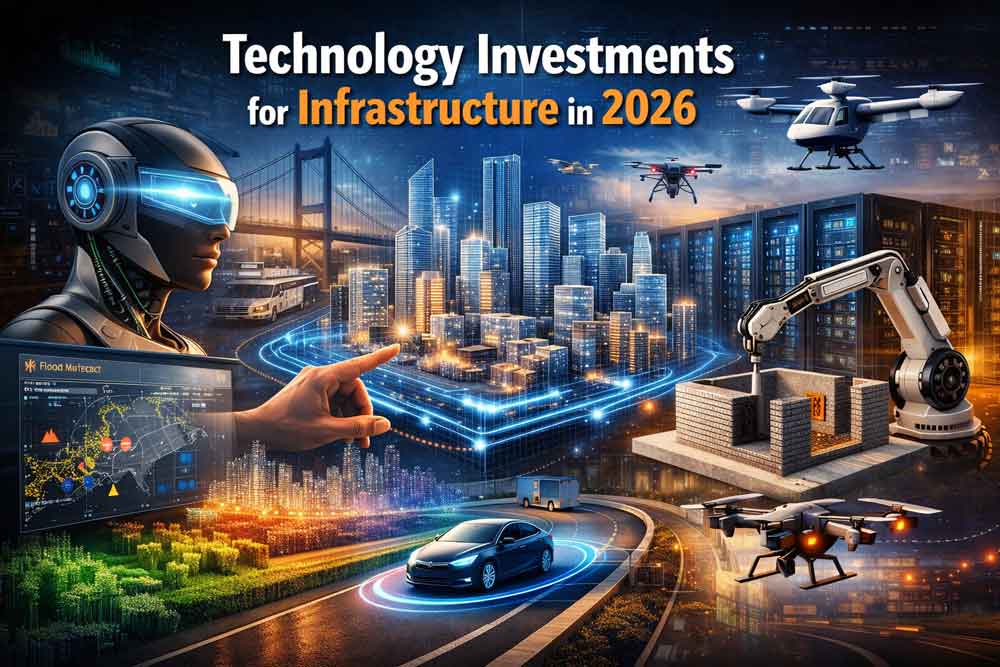
Which Technology Investments Deliver Measurable Infrastructure Value in 2026?
Infrastructure delivery in 2026 has moved decisively beyond experimentation into an era defined by performance accountability, system interoperability, and lifecycle intelligence. Technology investments are now judged not by novelty, but by their ability to produce quantifiable outcomes—reduced risk, optimized capital allocation, and sustained asset performance. Within the Architecture, Engineering, and Construction (AEC) sector, the convergence of advanced digital systems is fundamentally redefining how infrastructure is conceived, executed, and operated.
This analysis presents a high-level, engineering-driven perspective on the technologies that are creating real, scalable value across infrastructure ecosystems.
From Fragmented Tools to Integrated Digital Ecosystems
The defining characteristic of high-performing infrastructure organizations in 2026 is not the number of technologies deployed, but the degree of integration achieved. Siloed solutions—no matter how advanced—fail to deliver compounding value unless they are interconnected within a unified data architecture.
Digital maturity now depends on the orchestration of AI, geospatial intelligence, sensor networks, and cloud platforms into cohesive environments that support continuous data exchange. This integrated approach enables end-to-end visibility across the asset lifecycle, from early-stage planning to long-term operations and maintenance.
Enterprise AI & RAG 2.0: Governed Intelligence at Scale
Artificial Intelligence within AEC has matured into enterprise-grade infrastructure, moving away from generic, public large language models toward domain-specific, governed systems. These platforms are tightly integrated with internal knowledge bases, engineering standards, and project datasets, ensuring both security and contextual accuracy.
The emergence of Retrieval-Augmented Generation (RAG 2.0) introduces a critical layer of traceability. Engineering decisions can now be supported by verifiable data sources, significantly enhancing compliance, auditability, and trust in AI-assisted workflows.
With nearly three-quarters of AEC firms embedding AI into project delivery, the competitive advantage now lies in governance, integration, and data fidelity—not mere adoption.
Digital Twins: Operationalizing Lifecycle Intelligence
Digital twins have undergone a structural evolution from visualization-centric models to fully operational lifecycle intelligence platforms. These systems synthesize multi-source data streams—including design parameters, real-time sensor inputs, historical performance data, and predictive analytics—into continuously updated digital replicas of physical assets.
This transformation enables advanced capabilities such as scenario simulation, predictive failure modeling, and dynamic capital planning. By shifting from reactive to proactive asset management, organizations are achieving substantial reductions in operational expenditure, often approaching 30–35%.
Digital twins are no longer experimental—they are becoming foundational to infrastructure resilience and long-term value creation.
LiDAR & AI-Driven Change Detection: Enabling Predictive Infrastructure
The integration of high-resolution LiDAR scanning with AI-driven analytics is redefining asset intelligence. Modern point cloud datasets provide sub-centimeter accuracy, enabling comprehensive digital inventories of infrastructure components, from roadway geometry to drainage systems.
When analyzed across temporal datasets, these models evolve into predictive systems capable of quantifying deterioration rates, assessing structural integrity, and forecasting remaining service life. This time-based analytical capability represents a paradigm shift from condition-based monitoring to predictive asset management.
The result is a more strategic allocation of maintenance resources and a significant reduction in unplanned failures.
Advanced Visualization: Decision Validation at Scale
Visualization technologies have transitioned from supplementary tools to core decision-making infrastructure. Immersive environments, interactive models, and real-time simulations enable stakeholders to interrogate project designs before physical execution begins.
This capability facilitates early-stage validation, minimizes design conflicts, and accelerates regulatory approvals. More importantly, it bridges the communication gap between technical experts, policymakers, and community stakeholders, ensuring alignment across all levels of project governance.
Operational Intelligence: Real-Time, Context-Aware Systems
Operational intelligence platforms are transforming infrastructure from static systems into adaptive, data-driven environments. By leveraging cloud computing, AI, and real-time data ingestion, these systems maintain continuously updated models of infrastructure performance.
The ability to integrate live and forecasted data allows for precise, context-aware decision-making. For instance, predictive flood modeling now operates at the asset level, identifying specific vulnerabilities across transportation networks and urban systems before events occur.
This shift enhances resilience, reduces response times, and supports proactive risk mitigation strategies.
Autonomous & Connected Systems: Infrastructure as an Enabler
The evolution of autonomous mobility—spanning self-driving vehicles, automated freight systems, drone logistics, and eVTOL aircraft—is fundamentally dependent on infrastructure readiness.
This introduces new technical requirements, including ultra-precise geospatial mapping, real-time data synchronization, and integrated communication networks. Infrastructure is no longer a passive environment; it becomes an active participant in mobility ecosystems.
The pace of adoption will be dictated not by technological capability alone, but by the readiness and adaptability of supporting infrastructure systems.
Additive Construction: Redefining Build Methodologies
3D printing, or additive construction, is advancing rapidly through the adoption of robotic-arm systems capable of multi-axis fabrication. Unlike earlier fixed-rail approaches, these systems enable complex geometries and greater adaptability to site-specific constraints.
Coupled with innovations in material science—particularly advanced concrete formulations—additive construction is delivering improvements in speed, consistency, and labor efficiency. Its greatest impact is observed in high-volume, repeatable construction scenarios such as housing and modular infrastructure.
Data Center Infrastructure: The Backbone of Digital Expansion
The exponential growth of AI and digital services is placing unprecedented demands on data center infrastructure. These facilities are evolving to accommodate higher power densities, advanced cooling technologies, and complex grid interconnections.
Delivering such infrastructure requires multidisciplinary coordination across civil, structural, mechanical, electrical, and energy systems under compressed timelines. Data centers are no longer peripheral assets—they are central nodes in the global digital ecosystem, both enabling and depending on advanced infrastructure systems.
Drones & Physical AI: Extending Human Capability
The integration of physical AI into drones and robotic systems is extending operational capabilities across infrastructure environments. These systems are increasingly deployed for inspection, monitoring, construction support, and operations in hazardous or inaccessible locations.
As sensing technologies, autonomy, and decision-making algorithms advance, physical AI will play a critical role in augmenting human labor—particularly in tasks characterized by risk, repetition, or labor shortages.
The Strategic Imperative: Integration Over Isolation
A central conclusion for 2026 is that isolated technology investments fail to deliver sustained value. True transformation occurs when systems are architected for interoperability, enabling continuous data exchange and coordinated decision-making.
Organizations that successfully integrate AI, digital twins, LiDAR, and operational intelligence into unified platforms achieve:
- Higher data reliability and transparency
- Accelerated decision cycles
- Reduced lifecycle costs
- Enhanced system resilience
Integration is no longer an optimization strategy—it is a prerequisite for competitive performance.
Conclusion: Engineering the Future of Infrastructure
In 2026, infrastructure innovation is defined by precision, integration, and accountability. The technologies shaping the industry—enterprise AI, digital twins, predictive analytics, and intelligent automation—are most powerful when deployed as interconnected systems rather than standalone solutions.
The organizations that will lead the next decade of infrastructure development are those that move beyond adoption and focus on orchestration—aligning technology investments with engineering rigor, operational intelligence, and lifecycle value creation.
The future of infrastructure is not just digital—it is intelligently integrated, continuously adaptive, and engineered for long-term resilience.
Frequently Asked Questions (FAQs) – Infrastructure Technology Investments in 2026
1. What are the most valuable infrastructure technologies in 2026?
The most impactful technologies include enterprise AI, digital twins, LiDAR with AI-driven analytics, operational intelligence platforms, and advanced visualization systems. Their value lies in improving efficiency, reducing lifecycle costs, and enabling data-driven decision-making across infrastructure projects.
2. How is Artificial Intelligence transforming infrastructure projects?
AI is enabling automation, predictive analytics, and intelligent decision support. In 2026, enterprise-grade AI systems integrated with internal data sources provide accurate, traceable insights, improving design accuracy, risk management, and project delivery timelines.
3. What is the role of Digital Twins in modern infrastructure?
Digital twins act as dynamic, real-time replicas of physical assets. They integrate design, operational, and sensor data to enable predictive maintenance, scenario simulation, and long-term asset optimization, significantly reducing operational costs.
4. Why is integration more important than adopting individual technologies?
Isolated tools create data silos and inefficiencies. Integrated systems allow seamless data flow across platforms, improving coordination, enhancing decision-making, and maximizing the overall return on technology investments.
5. How does LiDAR technology improve infrastructure management?
LiDAR provides highly accurate 3D mapping of infrastructure assets. When combined with AI, it enables change detection over time, helping engineers assess asset conditions, predict deterioration, and plan maintenance proactively.
6. What is operational intelligence in infrastructure?
Operational intelligence refers to systems that use real-time and predictive data to monitor and manage infrastructure performance. These platforms provide actionable insights, helping organizations respond quickly to risks and optimize operations.
7. How are autonomous and connected vehicles impacting infrastructure?
They require advanced infrastructure support, including high-precision mapping, real-time communication networks, and integrated data systems. Infrastructure readiness is a key factor in enabling large-scale adoption of autonomous mobility.
8. Is 3D printing a viable solution for construction in 2026?
Yes, 3D printing is becoming increasingly viable, especially for repetitive and large-scale projects like housing. It offers faster construction, reduced labor costs, and greater design flexibility through advanced robotic systems and materials.
9. Why are data centers critical for infrastructure development?
Data centers support the growing demand for AI and digital services. Their development requires advanced engineering solutions for power, cooling, and connectivity, making them a central component of modern infrastructure ecosystems.
10. What is Physical AI and how is it used in infrastructure?
Physical AI refers to intelligent systems embedded in robots and drones. These technologies are used for inspections, monitoring, and operations in hazardous environments, improving safety and efficiency while reducing reliance on manual labor.