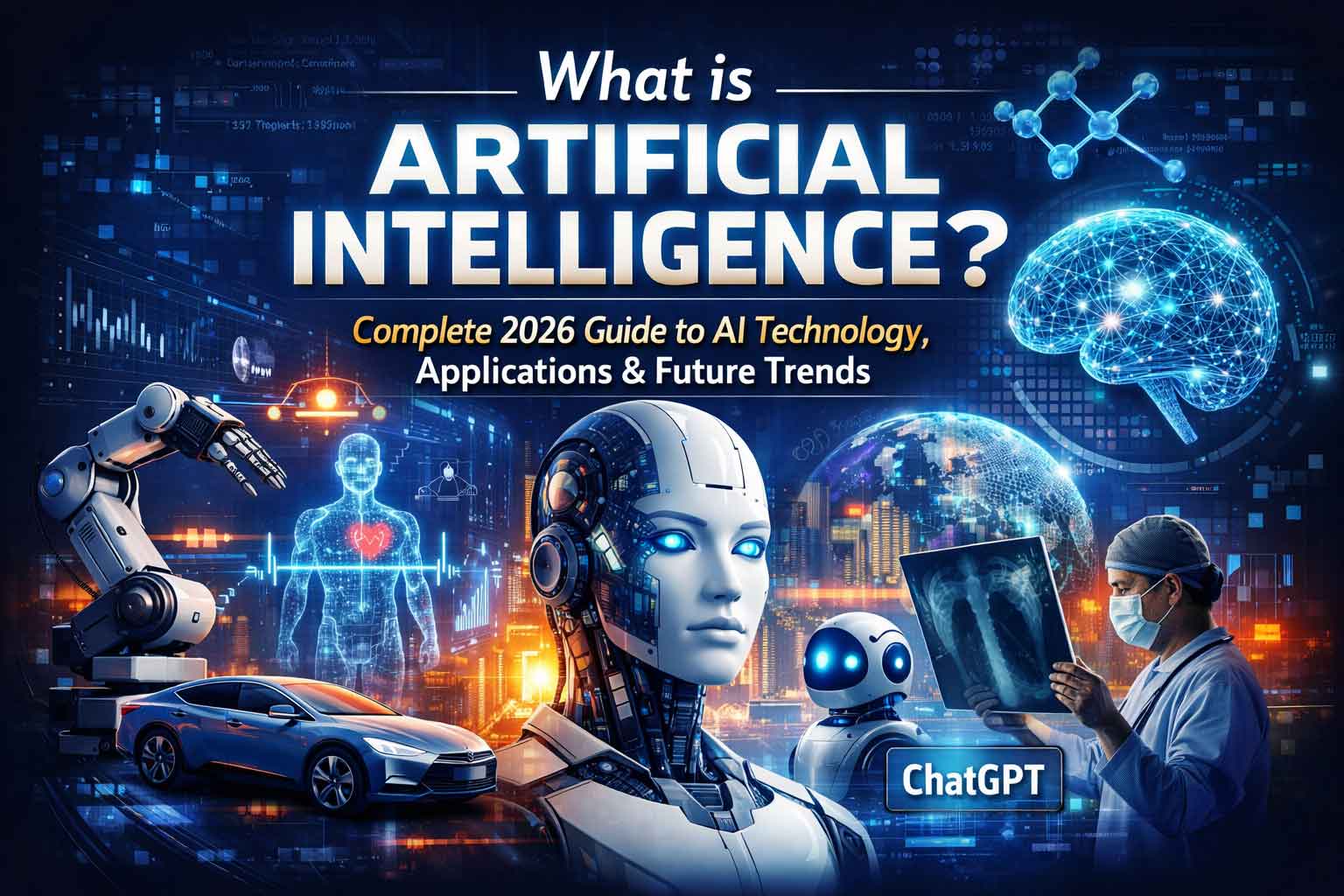
What is Artificial Intelligence? The Complete Guide to AI Technology, Applications, and Future Impact in 2026
Artificial intelligence has evolved from a futuristic concept into an indispensable technology reshaping every aspect of modern life. As we navigate through 2026, AI systems power everything from the smartphones in our pockets to life-saving medical diagnoses, autonomous vehicles navigating our cities, and creative tools generating art, music, and written content. This comprehensive guide explores what AI is, how it works, its transformative applications across industries, and what the future holds as we stand on the brink of even more revolutionary breakthroughs.
Understanding Artificial Intelligence in 2026: Beyond the Hype
Artificial intelligence (AI) represents the science and engineering of creating intelligent machines that can perceive their environment, learn from experience, reason through complex problems, and make decisions with minimal human intervention. Unlike traditional software that follows predetermined rules, AI systems adapt and improve their performance over time through exposure to data and feedback.
In 2026, AI has matured significantly from its experimental origins. Today’s AI ecosystem encompasses sophisticated technologies including machine learning algorithms, deep neural networks, natural language processing systems, computer vision platforms, and generative AI tools that create original content. Popular AI applications include conversational agents like ChatGPT, Claude, and Gemini; creative platforms like Midjourney and DALL-E; coding assistants like GitHub Copilot; and countless specialized systems powering business intelligence, medical diagnosis, financial trading, and manufacturing automation.
Modern AI development relies heavily on specialized programming languages—primarily Python, which dominates the field, alongside R for statistical computing, Java for enterprise applications, C++ for performance-critical systems, and Julia for high-performance numerical analysis. These languages provide the frameworks and libraries necessary to build, train, and deploy AI models at scale.
How Does Artificial Intelligence Work? The Technology Behind Intelligent Systems
Understanding how AI operates requires grasping several interconnected concepts. At its foundation, AI systems learn from data rather than being explicitly programmed for every possible scenario. This learning process enables AI to recognize patterns, make predictions, and generate insights that would be impossible for humans to extract manually from massive datasets.
The AI Learning Pipeline: From Raw Data to Intelligent Decisions
Modern AI systems typically follow a multi-stage process. First, they ingest enormous volumes of training data—this could be images, text, audio, sensor readings, or any other form of information relevant to the task. This data is carefully labeled and preprocessed to ensure quality and consistency.
Next, algorithms analyze this data to identify correlations, patterns, and statistical relationships. Machine learning models build mathematical representations of these patterns, creating what data scientists call “models” that encode the system’s understanding of the data.
Finally, these trained models make predictions or decisions when presented with new, previously unseen data. For example, an AI chatbot trained on millions of conversations can engage in natural dialogue, while an image recognition system trained on millions of photos can identify objects in new images with remarkable accuracy.
The breakthrough of 2020s-era generative AI lies in its ability to not just recognize patterns but to create entirely new content. Systems like ChatGPT, trained on vast text corpora, can generate coherent essays, computer code, poetry, and analysis. Image generators like Midjourney and Stable Diffusion create original artwork from text descriptions. These capabilities emerge from training on unprecedented scales of data using transformer architectures and other advanced neural network designs.
Four Essential Cognitive Capabilities Defining Modern AI
- Learning and Continuous Adaptation
AI systems excel at extracting knowledge from data and converting raw information into actionable insights. Through techniques like supervised learning, unsupervised learning, and reinforcement learning, AI algorithms discover patterns, build predictive models, and refine their understanding as they process more information. Modern AI systems can even perform transfer learning, applying knowledge gained in one domain to accelerate learning in related areas.
- Reasoning and Complex Decision-Making
Advanced AI systems reason through multi-step problems, weighing competing objectives and constraints to reach optimal solutions. This goes beyond simple pattern matching—modern AI can plan sequences of actions, evaluate hypothetical scenarios, and make strategic decisions in complex, uncertain environments. Chess-playing AI, autonomous vehicle navigation systems, and AI-powered financial trading platforms all demonstrate sophisticated reasoning capabilities.
- Self-Correction and Performance Optimization
Through feedback loops and continuous training, AI systems identify their own errors and adjust their parameters to improve accuracy. This self-improvement happens automatically—when a spam filter misclassifies an email, user corrections help it learn. When a recommendation engine suggests irrelevant products, lack of engagement signals the need for adjustment. This constant refinement is what allows AI systems to become more accurate and useful over time.
- Creativity and Generative Capabilities
Perhaps the most remarkable recent development is AI’s creative capacity. Generative AI systems produce novel text, images, music, video, 3D models, computer code, and even molecular structures for drug discovery. These systems don’t simply remix existing content—they synthesize new creations by learning the underlying patterns and principles of their training data. Artists, writers, musicians, and programmers increasingly collaborate with AI tools to enhance their creative output and explore possibilities beyond human imagination alone.
Why Artificial Intelligence Matters More Than Ever in 2026
The integration of AI into business, government, healthcare, education, and daily life has accelerated dramatically. As of early 2026, AI is no longer a competitive advantage—it’s a competitive necessity. Organizations that fail to adopt AI risk obsolescence, while those that implement it thoughtfully gain unprecedented capabilities in efficiency, insight, and innovation.
Business Transformation Through AI Adoption
Companies across every sector leverage AI to automate routine tasks, personalize customer experiences, optimize operations, and unlock new business models. Customer service operations deploy AI chatbots and virtual agents handling millions of inquiries simultaneously. Sales teams use AI for lead scoring, pipeline prediction, and personalized outreach. Marketing departments employ AI for content generation, campaign optimization, and customer segmentation.
Manufacturing facilities use computer vision for quality control, predictive maintenance algorithms to prevent equipment failures, and AI-optimized supply chains that adapt to disruptions in real-time. Financial services firms employ AI for fraud detection, algorithmic trading, credit risk assessment, and personalized financial advice. Retailers use recommendation engines, dynamic pricing, inventory optimization, and virtual shopping assistants.
Tech giants like Alphabet, Apple, Microsoft, Meta, and Amazon have woven AI throughout their products and services. Google’s search algorithms, Gmail’s smart compose, YouTube’s recommendation system, and Google Photos’ organization all rely on sophisticated AI. Microsoft Copilot integrates AI across Office applications, while Amazon’s fulfillment centers use AI-powered robots working alongside humans.
Perhaps most remarkably, AI has enabled entirely new categories of business. Uber, DoorDash, and similar platforms exist only because AI can match supply and demand, optimize routes, and predict delivery times with precision impossible through manual coordination. The creator economy thrives partly because AI tools democratize content creation, editing, and distribution.
12 Game-Changing Advantages of Artificial Intelligence Technology
1. Superhuman Accuracy in Pattern Recognition
AI systems detect subtle patterns in data that human analysts would never notice. In medical imaging, AI identifies early-stage cancers, diabetic retinopathy, and cardiovascular abnormalities with accuracy matching or exceeding experienced radiologists. In cybersecurity, AI recognizes attack patterns across millions of events, identifying threats that would slip past human security analysts. In quality control, computer vision systems spot microscopic defects in manufacturing that human inspectors miss.
2. Processing Massive Data Volumes at Unprecedented Speed
Where human analysts might take months to review millions of documents, AI systems process the same volume in hours or minutes. Financial institutions analyze market data from thousands of sources simultaneously. Legal discovery teams use AI to review millions of pages of documents for relevant information. Climate scientists process satellite imagery covering entire continents to track environmental changes in real-time.
3. Dramatic Productivity Gains Across Knowledge Work
AI coding assistants help developers write code faster with fewer bugs. AI writing tools help content creators produce drafts, summaries, and variations more efficiently. AI research assistants help scientists analyze literature and design experiments. These productivity improvements don’t replace human expertise—they amplify it, allowing professionals to accomplish more and focus on higher-value creative and strategic work.
4. Elimination of Human Bias (When Properly Designed)
Well-designed AI systems make consistent decisions based purely on relevant factors, avoiding the unconscious biases that affect human judgment. In hiring, AI can evaluate candidates based solely on qualifications and fit. In lending, AI assesses creditworthiness using objective financial data. In diagnosis, AI evaluates symptoms without being influenced by patient demographics. However, this advantage only materializes when AI systems are carefully designed, tested, and monitored for fairness.
5. Personalization at Individual Scale
AI enables mass personalization previously impossible. Streaming services curate content for each viewer. E-commerce platforms show different products to different customers based on preferences and behavior. Educational platforms adapt difficulty and pacing to individual students. Healthcare systems tailor treatment recommendations to patient-specific factors including genetics, lifestyle, and medical history. This personalization improves engagement, satisfaction, and outcomes across virtually every consumer-facing application.
6. Always-On Availability Without Fatigue
AI systems operate 24/7/365 without breaks, vacation, or performance degradation from fatigue. Customer service chatbots handle inquiries at 3 AM with the same quality as at 3 PM. Monitoring systems watch for security threats, equipment failures, or market opportunities around the clock. This constant availability dramatically improves service levels while reducing operational costs.
7. Infinite Scalability for Growing Demands
Adding capacity to AI systems typically requires only additional computing resources, not proportional increases in human headcount. A customer service AI handles the 10,000th conversation with the same effort as the first. A fraud detection system monitors 10 million transactions as easily as 1 million. This scalability enables global services that would be economically impossible with human-only operations.
8. Revolutionary Scientific and Medical Breakthroughs
AI accelerates scientific discovery across fields. In drug development, AI predicts molecular properties and designs new compounds, compressing years of laboratory work into months. In materials science, AI discovers new alloys and polymers with desired properties. In genomics, AI identifies disease-causing mutations and suggests personalized treatments. In climate science, AI models predict weather patterns and climate impacts with increasing accuracy. These capabilities are fundamentally accelerating human knowledge and innovation.
9. Enhanced Safety in Dangerous Environments
AI-powered robots and autonomous systems handle dangerous tasks that would risk human life. In mining, autonomous vehicles operate in hazardous underground environments. In nuclear facilities, robots perform inspections and maintenance in radioactive areas. In disaster response, drones and robots search collapsed buildings and assess dangerous sites. In manufacturing, cobots handle toxic materials and perform ergonomically demanding tasks that cause repetitive strain injuries.
10. Environmental Sustainability and Conservation
AI contributes significantly to environmental protection and climate action. Smart grids use AI to optimize renewable energy distribution and reduce waste. Precision agriculture employs AI to minimize water, fertilizer, and pesticide use while maximizing yields. Wildlife conservation programs use computer vision to monitor endangered species and detect poaching. Climate models use AI to predict changes and evaluate intervention strategies. Energy-intensive industries use AI to optimize processes and reduce emissions.
11. Accessibility and Inclusion Improvements
AI technologies enhance accessibility for people with disabilities. Real-time speech-to-text enables communication for deaf and hard-of-hearing individuals. Text-to-speech and screen readers powered by advanced NLP help blind users navigate digital content. Computer vision applications describe visual scenes for visually impaired users. AI-powered prosthetics respond to neural signals, restoring mobility and independence. Language translation breaks down communication barriers across linguistic communities.
12. Predictive Capabilities for Proactive Decision-Making
AI’s predictive power enables organizations to anticipate problems and opportunities rather than merely reacting to them. Predictive maintenance prevents equipment failures before they occur. Demand forecasting optimizes inventory and staffing. Predictive analytics identify at-risk patients before medical crises. Financial models predict market movements and portfolio risks. These capabilities transform reactive organizations into proactive ones, improving outcomes while reducing costs.
Critical Challenges and Risks of AI Implementation in 2026
Despite AI’s transformative potential, significant challenges persist. Understanding these limitations is essential for responsible AI development and deployment.
1. Enormous Financial Investment Requirements
Developing sophisticated AI systems demands massive capital investment. Training large language models costs tens to hundreds of millions of dollars in computing resources. OpenAI’s GPT-4 training exceeded $100 million, and newer models cost even more. Beyond initial development, ongoing inference costs, model updates, and infrastructure maintenance create substantial recurring expenses. Smaller organizations often cannot compete with tech giants’ AI capabilities due to these financial barriers.
2. Severe Talent Shortage and Skills Gap
Demand for AI talent dramatically exceeds supply. Machine learning engineers, data scientists, AI researchers, and MLOps specialists command premium salaries, yet organizations struggle to fill positions. The skills required differ significantly from traditional software development, requiring expertise in statistics, linear algebra, optimization theory, and domain-specific knowledge. This talent scarcity slows AI adoption and increases project costs.
3. Algorithmic Bias and Fairness Concerns
AI systems inherit and amplify biases present in training data. Historical data reflecting past discrimination becomes encoded in AI decisions affecting hiring, lending, criminal justice, and resource allocation. Amazon’s AI recruiting tool showed gender bias. Facial recognition systems demonstrate higher error rates for darker-skinned individuals. Healthcare AI trained on non-representative populations may provide suboptimal care for underrepresented groups. Addressing bias requires constant vigilance, diverse teams, careful data curation, and ongoing auditing.
4. Limited Generalization and Brittleness
AI systems excel at their trained tasks but struggle outside their specific domains. An AI trained to diagnose pneumonia from chest X-rays may fail completely with different imaging equipment or patient populations. Language models trained primarily on English perform poorly in other languages. Small changes in input format can cause dramatic performance drops. This brittleness means organizations must develop and maintain many specialized models rather than general-purpose systems.
5. Job Displacement and Economic Disruption
AI automation threatens millions of jobs across white-collar and blue-collar sectors. Customer service representatives, data entry workers, truck drivers, radiologists, paralegals, and content writers all face displacement risk. While AI creates new roles, they don’t directly replace displaced jobs, potentially exacerbating inequality. Reskilling workers at scale presents enormous societal challenges. The transition could create widespread economic hardship if not managed thoughtfully through education, social safety nets, and economic policy.
6. Cybersecurity Vulnerabilities and Adversarial Attacks
AI systems face unique security threats. Adversarial examples—inputs deliberately designed to fool AI—can cause image classifiers to misidentify stop signs or facial recognition to misidentify people. Data poisoning attacks corrupt training data to manipulate model behavior. Model extraction attacks steal proprietary AI systems. As AI controls increasingly critical systems—autonomous vehicles, medical devices, financial markets—these vulnerabilities pose serious safety and security risks.
7. Massive Environmental Impact
Training large AI models consumes enormous energy and water for data center cooling. Training a single large language model can emit as much carbon as several cars over their entire lifetimes. As AI deployment scales globally, these environmental costs multiply. Researchers estimate AI’s energy consumption could rival entire countries’ usage by the end of the decade unless efficiency improvements accelerate dramatically.
8. Privacy Erosion and Surveillance Concerns
AI enables unprecedented surveillance capabilities. Facial recognition tracks individuals across public spaces. Behavioral analytics profile users based on digital activity. AI analyzes communications for sentiment, intent, and relationships. While these capabilities enable valuable applications in security and personalization, they also create potential for abuse by corporations and governments. The balance between AI’s benefits and privacy protection remains contentious.
9. Lack of Transparency and Explainability
Deep learning models often function as “black boxes,” making decisions through inscrutable internal processes. When AI denies a loan, recommends medical treatment, or makes hiring decisions, affected individuals deserve explanations—yet the AI itself cannot always provide them. This opacity creates problems for regulatory compliance, debugging errors, building trust, and ensuring accountability. Explainable AI (XAI) research addresses these issues but hasn’t fully solved them.
10. Complex Legal and Ethical Questions
AI raises thorny questions about liability, accountability, and rights. Who’s responsible when autonomous vehicles cause accidents? Can AI-generated content infringe copyright? Should AI systems trained on copyrighted material compensate creators? Do AI systems have rights? Can they be held accountable? Legal frameworks developed for human decision-makers often don’t translate cleanly to AI systems, creating regulatory uncertainty and potential for harm.
11. Deepfakes and Misinformation Amplification
Generative AI creates realistic fake images, videos, and audio of people saying or doing things they never did. These deepfakes enable new forms of fraud, harassment, and political manipulation. AI also generates convincing misinformation at scale, potentially overwhelming fact-checking efforts. As synthetic content becomes indistinguishable from authentic material, trust in digital media erodes with profound implications for democracy and social cohesion.
12. Concentration of Power in Tech Giants
The enormous resources required for cutting-edge AI development concentrate power in a handful of large technology companies and well-funded startups. This concentration creates concerns about monopolistic behavior, reduced innovation diversity, and unequal access to transformative technology. Smaller organizations, developing nations, and marginalized communities risk being left behind in the AI revolution, potentially exacerbating existing inequalities.
Narrow AI vs. Artificial General Intelligence: Where We Are and Where We’re Heading
Understanding the difference between narrow AI (also called weak AI) and artificial general intelligence (AGI, also called strong AI) is crucial for setting realistic expectations about AI’s current capabilities and future trajectory.
Narrow AI: Today’s Specialized Intelligence Systems
Every AI system currently deployed—without exception—falls into the narrow AI category. These systems excel at specific tasks for which they’re trained but cannot transfer that expertise to unrelated domains. A chess-playing AI cannot drive cars. A medical diagnosis AI cannot translate languages. An image generation AI cannot write code.
Examples of narrow AI surround us. Virtual assistants like Siri, Alexa, and Google Assistant understand voice commands and answer questions within defined domains. Recommendation engines on Netflix, Spotify, and YouTube predict what content you’ll enjoy. Spam filters classify emails. Fraud detection systems flag suspicious transactions. Autonomous vehicles navigate roads. Medical imaging systems detect diseases.
Even the most impressive large language models—ChatGPT, Claude, Gemini, and others—remain narrow AI. Despite their ability to engage in seemingly intelligent conversation across many topics, they cannot truly understand context the way humans do, cannot form genuine intentions, cannot experience the world, and cannot reliably reason through novel problems requiring common sense or causal understanding. They excel at pattern matching and statistical language generation but lack genuine comprehension and general intelligence.
Artificial General Intelligence: The Holy Grail of AI Research
AGI refers to hypothetical AI systems with human-level intelligence across all cognitive domains. An AGI could understand natural language, reason abstractly, learn new skills from minimal examples, transfer knowledge between domains, understand causation, form plans, and adapt to entirely novel situations—essentially matching or exceeding human cognitive flexibility.
AGI remains firmly in the realm of research and speculation. Experts disagree dramatically about whether AGI is achievable, and if so, when. Optimistic predictions suggest AGI might arrive in the 2030s or 2040s. Skeptics argue it may take centuries or prove impossible with current approaches. Some researchers believe AGI requires fundamentally different architectures than today’s deep learning systems, while others think scaling current approaches will eventually produce general intelligence.
The path to AGI faces enormous challenges. Current AI lacks true understanding, common sense reasoning, and the ability to build causal models of the world. AI systems cannot reliably distinguish correlation from causation, struggle with tasks requiring physical intuition, and fail at problems trivial for human toddlers. Achieving AGI likely requires breakthroughs in areas like reasoning, knowledge representation, transfer learning, and possibly consciousness and self-awareness—problems that remain poorly understood.
The concept of the “technological singularity” suggests that once AGI is achieved, it could rapidly improve itself, leading to artificial superintelligence far exceeding human cognitive abilities. Such a development would represent a profound discontinuity in human history, with implications—both positive and catastrophic—that are difficult to predict. This possibility motivates both enthusiastic pursuit of AGI and calls for extreme caution in its development.
Four Categories of AI: A Framework for Understanding AI Capabilities
AI researchers commonly categorize systems into four types based on capability levels, from simple reactive systems to hypothetical conscious machines.
Type 1: Reactive Machines—Pure Response Without Memory
Reactive machines operate entirely in the present moment, with no memory of past experiences and no ability to learn. They analyze current inputs and generate outputs based on predefined rules or patterns, but they don’t improve over time or adapt to new situations.
IBM’s Deep Blue, which defeated world chess champion Garry Kasparov in 1997, exemplifies reactive AI. Deep Blue evaluated millions of possible chess positions and selected optimal moves but didn’t learn from previous games or develop new strategies. Each game started from scratch. While impressive for its time, reactive machines represent AI’s most basic form.
Type 2: Limited Memory AI—Learning from Historical Data
Limited memory systems can reference past experiences to inform current decisions. They don’t store complete historical records indefinitely but maintain relevant recent information to improve performance.
Most contemporary AI falls into this category. Self-driving cars observe other vehicles’ behavior, road conditions, and traffic patterns to make navigation decisions. Recommendation systems track user preferences and behaviors to suggest relevant content. Large language models learn from training data and can reference conversation history within a session. This limited memory enables adaptive behavior and personalization but still doesn’t constitute true general intelligence.
Type 3: Theory of Mind AI—Understanding Mental States (Theoretical)
Theory of mind AI would understand that others have beliefs, desires, intentions, and emotions distinct from its own. It would infer human mental states, predict behavior based on psychological understanding, and interact naturally in social contexts requiring empathy and emotional intelligence.
This capability doesn’t currently exist. While some systems can recognize emotional expressions or generate appropriate emotional responses, they don’t genuinely understand emotions or mental states. Developing theory of mind AI requires solving profound problems in consciousness, self-awareness, and social cognition that remain at research’s frontiers. Successfully creating such systems would represent a major step toward AGI.
Type 4: Self-Aware AI—Conscious Machines (Does Not Exist)
The most advanced theoretical AI category encompasses systems with consciousness, self-awareness, and subjective experience. Self-aware AI would understand its own existence, have desires and goals, experience emotions, and possess something analogous to human consciousness.
Such systems remain purely speculative. We don’t understand consciousness well enough to create it artificially—indeed, we don’t fully understand what consciousness is or how it emerges from biological brains. Questions about whether machines could be conscious, how we would know, and what moral status conscious AI would have remain deeply philosophical and unresolved. Self-aware AI appears in science fiction but not in any laboratory or data center.
Essential AI Technologies Powering the 2026 Revolution
Machine Learning: The Engine of Modern AI
Machine learning (ML) forms the foundation of contemporary AI systems. Rather than programming explicit rules, ML algorithms learn patterns from data and improve through experience.
Supervised Learning trains models on labeled examples—input-output pairs showing desired behavior. The model learns to map inputs to outputs by minimizing prediction errors. Applications include image classification, spam detection, voice recognition, and fraud identification. Deep learning, using artificial neural networks with many layers, represents the most powerful supervised learning approach and drives breakthroughs in computer vision and natural language processing.
Unsupervised Learning discovers patterns in unlabeled data without predefined categories. Clustering algorithms group similar items. Dimensionality reduction techniques identify key features in high-dimensional data. Anomaly detection finds unusual patterns. These approaches excel at customer segmentation, data compression, and exploratory analysis where we don’t know in advance what patterns exist.
Reinforcement Learning trains agents to make sequences of decisions by rewarding desired outcomes. The agent explores an environment, receives feedback on its actions, and learns strategies maximizing cumulative rewards. This approach powers game-playing AI, robotics, autonomous vehicles, and optimization systems. DeepMind’s AlphaGo and AlphaZero mastered Go and chess through reinforcement learning, discovering novel strategies human experts hadn’t conceived.
Semi-Supervised and Self-Supervised Learning combine elements of supervised and unsupervised approaches. These techniques leverage small amounts of labeled data alongside large volumes of unlabeled data, reducing annotation costs while achieving strong performance. Modern large language models use self-supervised learning extensively, training on unlabeled text by predicting masked words or next tokens.
Deep Learning and Neural Networks: Mimicking Brain Structure
Deep learning uses artificial neural networks inspired by biological brain structure. These networks consist of layers of interconnected nodes (neurons) that process information through weighted connections. Deep networks contain many layers, allowing them to learn hierarchical representations—from simple features like edges and textures to complex concepts like objects and scenes.
Key architectures include convolutional neural networks (CNNs) for image processing, recurrent neural networks (RNNs) for sequential data, and transformers for language understanding. Transformers, introduced in Google’s 2017 “Attention Is All You Need” paper, revolutionized NLP and now dominate across domains including computer vision and multimodal learning.
Natural Language Processing: Teaching Machines to Understand Language
NLP enables computers to process, understand, and generate human language. Modern NLP systems perform translation, summarization, question answering, sentiment analysis, named entity recognition, and conversational interaction.
Large language models (LLMs) like GPT-4, Claude, Gemini, and Llama represent NLP’s current pinnacle. Trained on trillions of words from books, websites, and other sources, these models develop broad language understanding and generation capabilities. They can write essays, answer questions, translate languages, write code, summarize documents, and engage in extended dialogue. However, they also hallucinate false information, lack genuine understanding, and exhibit biases from training data.
Computer Vision: Giving Machines the Sense of Sight
Computer vision teaches machines to interpret visual information from cameras and sensors. Applications include object detection and recognition, facial recognition, medical image analysis, autonomous navigation, quality inspection, and gesture recognition.
Modern computer vision relies heavily on deep convolutional neural networks that learn hierarchical visual features. These systems match or exceed human performance on many visual tasks, from identifying objects in photos to detecting tumors in medical scans. Multimodal models that combine vision and language understanding enable applications like image captioning, visual question answering, and text-to-image generation.
Robotics and Embodied AI: Intelligence in the Physical World
Robotics integrates AI with mechanical systems to create machines that sense, reason about, and act in the physical world. AI enables robots to navigate dynamic environments, manipulate objects, collaborate with humans, and adapt to unexpected situations.
Industrial robots perform assembly, welding, painting, and packaging in manufacturing. Service robots clean floors, deliver items, and assist in healthcare. Exploration robots venture into environments too dangerous or remote for humans—deep oceans, disaster sites, other planets. Collaborative robots (cobots) work alongside humans in shared workspaces, combining AI’s precision and tirelessness with human flexibility and judgment.
Autonomous Vehicles: Self-Driving Transportation
Autonomous vehicles combine multiple AI technologies—computer vision for perceiving the environment, sensor fusion for integrating data from cameras, lidar, and radar, path planning for navigation, and control systems for steering and speed. Machine learning enables these systems to improve from experience, adapting to diverse conditions and edge cases.
By 2026, autonomous vehicle technology has advanced significantly. Limited self-driving features assist drivers on highways and in traffic. Fully autonomous vehicles operate in geofenced areas for applications like delivery, shuttle services, and ride-hailing in select cities. However, achieving full autonomy in all conditions remains elusive—bad weather, construction zones, unpredictable human behavior, and rare edge cases continue challenging even the most sophisticated systems.
Generative AI: Creating Original Content
Generative AI systems create new content rather than merely analyzing existing data. These systems generate text, images, audio, video, 3D models, computer code, molecular structures, and more from text prompts or other inputs.
Text generation models like ChatGPT, Claude, and Gemini produce articles, stories, code, analysis, and conversation. Image generators like DALL-E, Midjourney, and Stable Diffusion create artwork, designs, and visualizations. Audio generators create realistic speech, music, and sound effects. Video generators create short clips and are rapidly improving. Code generation tools like GitHub Copilot assist programmers.
These tools democratize creation, enabling people without specialized skills to produce professional-quality content. They also raise concerns about copyright infringement, misinformation, deepfakes, and the displacement of creative professionals. The balance between empowerment and disruption remains contested as generative AI capabilities continue advancing rapidly.
AI Transforming Industries: Real-World Applications in 2026
Healthcare: Revolutionizing Diagnosis, Treatment, and Drug Discovery
AI is transforming healthcare across diagnosis, treatment planning, drug discovery, and administrative operations. Medical imaging AI detects cancers, cardiovascular disease, and neurological conditions from X-rays, CT scans, and MRIs—often matching or exceeding radiologist accuracy. AI analyzes pathology slides, retinal images, and skin lesions for disease diagnosis.
Predictive models identify patients at risk for sepsis, hospital readmission, or disease progression, enabling earlier intervention. AI assists treatment planning in radiation oncology and surgery. Virtual health assistants handle appointment scheduling, medication reminders, and preliminary symptom assessment. Administrative AI processes insurance claims, medical coding, and billing.
In drug discovery, AI predicts molecular properties, designs novel compounds, and identifies promising drug candidates from millions of possibilities. This accelerates development timelines from years to months. AI also matches patients to clinical trials and analyzes genomic data for personalized medicine approaches tailored to individual genetic profiles.
Business and Enterprise: Optimizing Operations and Strategy
Businesses deploy AI across every function. Customer service uses chatbots and virtual agents handling routine inquiries, escalating complex issues to humans. Sales teams leverage AI for lead scoring, pipeline prediction, next-best-action recommendations, and automated outreach personalization.
Marketing employs AI for customer segmentation, content generation, campaign optimization, attribution modeling, and sentiment analysis. HR departments use AI for resume screening, candidate matching, employee retention prediction, and learning recommendations. Finance teams deploy AI for forecasting, fraud detection, risk assessment, and process automation.
Supply chain operations use AI for demand forecasting, inventory optimization, route planning, and disruption prediction. Manufacturing leverages computer vision for quality control, predictive maintenance for equipment, production optimization, and safety monitoring. Business intelligence platforms use AI to surface insights, generate reports, and answer natural language questions about data.
Education: Personalizing Learning at Scale
Educational technology increasingly integrates AI to personalize learning, automate administrative tasks, and provide accessibility. Adaptive learning platforms adjust content difficulty, pacing, and presentation based on individual student performance and learning style. AI tutors provide personalized support, answer questions, and offer additional practice on challenging concepts.
Automated grading systems handle multiple-choice tests, short answers, and even essays, providing immediate feedback and freeing instructor time for higher-value interactions. AI-powered learning analytics identify struggling students early, predict dropout risk, and recommend interventions.
Tools like ChatGPT and other LLMs assist students with research, writing, and problem-solving—though they also challenge traditional assessment methods and raise academic integrity concerns. Educators use AI to generate lesson plans, create practice problems, and develop teaching materials. However, schools and universities continue grappling with policies around AI use, plagiarism detection, and maintaining educational rigor.
Finance and Banking: Risk Management and Algorithmic Trading
Financial services lead AI adoption across fraud detection, credit scoring, algorithmic trading, risk assessment, and customer service. AI analyzes transaction patterns to identify fraudulent activity in real-time, blocking suspicious transactions before completion. Credit scoring models evaluate borrower risk using broader data sources than traditional credit reports, potentially expanding access while managing risk.
Algorithmic trading systems execute trades at superhuman speeds based on market analysis, news sentiment, and predictive models. Portfolio management AI optimizes asset allocation, rebalancing based on risk tolerance and market conditions. Robo-advisors provide automated investment advice and management to retail investors at low cost.
Customer service chatbots handle banking inquiries, transaction assistance, and product recommendations. AI-powered apps like TurboTax provide personalized tax preparation guidance. Insurance companies use AI for claims processing, risk assessment, and fraud detection. Regulatory technology (RegTech) employs AI for compliance monitoring and reporting.
Legal Services: Document Analysis and Case Research
Law firms and corporate legal departments deploy AI for document review, legal research, contract analysis, and due diligence. E-discovery AI rapidly reviews millions of documents for relevance in litigation, extracting key information and identifying patterns human reviewers would miss or take months to find.
Contract analysis systems extract terms, identify risks, ensure compliance with standards, and flag unusual provisions. Legal research AI searches case law, statutes, and regulations to find relevant precedents and build arguments. Predictive analytics forecast case outcomes, settlement values, and judicial decisions based on historical patterns.
Generative AI increasingly assists with drafting standard documents like contracts, briefs, and memos—though human review remains essential for accuracy and strategy. These tools dramatically improve efficiency, allowing legal professionals to focus on judgment, strategy, and client relationships rather than document-intensive tasks.
Manufacturing: Automation and Quality Control
Manufacturing operations integrate AI throughout production processes. Computer vision systems inspect products for defects with superhuman accuracy and consistency, identifying microscopic flaws invisible to human inspectors. Predictive maintenance AI analyzes sensor data from equipment to forecast failures before they occur, scheduling maintenance to minimize downtime and prevent catastrophic breakdowns.
Production optimization AI adjusts parameters in real-time to maximize efficiency, quality, and throughput while minimizing waste and energy consumption. Supply chain AI coordinates materials flow, inventory levels, and production scheduling across complex networks. Collaborative robots work alongside human workers on assembly lines, combining AI precision with human adaptability.
Generative design AI creates optimized product designs based on specified constraints and objectives, discovering solutions human engineers might not conceive. Digital twins—virtual replicas of physical systems—use AI to simulate operations, test changes, and optimize performance without disrupting actual production.
Transportation and Logistics: Route Optimization and Fleet Management
Beyond autonomous vehicles, AI transforms transportation through traffic management, route optimization, and logistics coordination. Smart traffic systems adjust signal timing based on real-time conditions, reducing congestion and emissions. Fleet management AI optimizes routes, schedules maintenance, monitors driver behavior, and predicts fuel consumption.
Airlines use AI to predict delays, optimize crew scheduling, manage pricing dynamically, and improve maintenance planning. Shipping companies employ AI for route optimization, weather routing, fuel optimization, and port operations coordination. Delivery companies use AI for last-mile optimization, package sorting, and delivery time prediction.
Ride-sharing platforms like Uber and Lyft use AI to match riders with drivers, predict demand, optimize pricing, and estimate arrival times. Public transportation systems use AI for schedule optimization, crowding prediction, and maintenance planning. These applications improve efficiency, reduce costs, and enhance user experiences across transportation modes.
Retail and E-commerce: Personalization and Inventory Management
Retail businesses leverage AI for personalized recommendations, dynamic pricing, inventory optimization, and customer service. Recommendation engines analyze browsing history, purchase patterns, and similar customers to suggest relevant products, driving significant portions of e-commerce revenue.
Computer vision enables cashierless stores where customers grab items and leave, with AI handling checkout automatically. Virtual try-on applications use AR and AI to show how clothing, makeup, or furniture would look. Chatbots assist customers with product selection, size recommendations, and order tracking.
Inventory management AI predicts demand, optimizes stock levels, and triggers automatic reordering. Pricing algorithms adjust prices dynamically based on demand, competition, inventory levels, and customer segments. Visual search allows customers to find products by uploading photos rather than typing descriptions.
Agriculture: Precision Farming and Crop Optimization
Agricultural AI enables precision farming techniques that optimize resource use while maximizing yields. Computer vision analyzes drone and satellite imagery to monitor crop health, identify pest infestations, detect diseases, and assess irrigation needs at plant-level granularity.
AI-powered robots perform selective harvesting, identifying ripe produce and picking it without damaging plants. Autonomous tractors and farm equipment operate with GPS precision for planting, spraying, and harvesting. Predictive models forecast yields, optimal harvest timing, and market prices to inform business decisions.
Livestock monitoring systems use computer vision and sensors to track animal health, behavior, and productivity. AI optimizes feed formulations, breeding programs, and barn climate control. These technologies increase productivity and sustainability while reducing environmental impact through efficient resource use.
As AI capabilities expand and deployment accelerates, ethical considerations become increasingly urgent. The AI community, policymakers, and society broadly are grappling with how to develop and deploy AI responsibly, maximizing benefits while minimizing harms.
Key Ethical Principles for AI Development
Fairness and Non-Discrimination: AI systems should treat all people equitably, avoiding bias based on race, gender, age, disability, or other protected characteristics. This requires careful attention to training data composition, algorithm design, and ongoing monitoring for disparate impacts.
Transparency and Explainability: People affected by AI decisions deserve to understand how those decisions were made. This requires both technical transparency (documenting model architectures, training data, performance metrics) and explainability (providing human-understandable reasons for specific decisions).
Privacy and Data Protection: AI systems must respect individual privacy, collect only necessary data, secure that data against breaches, and provide individuals control over their information. This becomes especially critical as AI systems process increasingly intimate personal data.
Accountability and Responsibility: Organizations deploying AI must take responsibility for its impacts. This includes establishing governance structures, conducting impact assessments, monitoring for problems, and having mechanisms to address harms when they occur.
Safety and Robustness: AI systems should work reliably, fail gracefully when they do fail, and not cause harm. This requires extensive testing, validation, monitoring in deployment, and designing systems that maintain safe operation even when encountering unexpected inputs or situations.
Human Agency and Control: AI should augment and empower humans rather than replacing human judgment in high-stakes decisions. Systems should allow human oversight, intervention, and the ability to override AI decisions when appropriate.
Addressing Algorithmic Bias and Fairness
Algorithmic bias represents one of AI’s most pressing ethical challenges. AI systems trained on historical data inevitably reflect historical biases—discrimination in hiring, lending, criminal justice, and other domains becomes encoded in algorithms and perpetuated at scale.
Addressing bias requires multi-faceted approaches: diverse development teams bringing different perspectives, careful curation of representative training data, technical debiasing methods, ongoing auditing for disparate impacts, and willingness to not deploy AI when fairness cannot be ensured. Regulatory requirements increasingly mandate bias testing and fairness documentation before deployment in high-risk applications.
Combating Deepfakes and AI-Generated Misinformation
Generative AI’s ability to create convincing fake content poses serious risks to truth, trust, and democracy. Deepfake technology creates realistic videos of people saying things they never said, enables fraud and harassment, and could influence elections or incite violence.
Responses include technical solutions like watermarking AI-generated content, developing detection tools, and building authentication systems. Social and policy solutions include media literacy education, platform policies against synthetic media misuse, and legal frameworks criminalizing malicious deepfakes. However, the arms race between generation and detection capabilities continues, with no definitive solution yet achieved.
Intellectual Property and Creative Rights
AI training on copyrighted material raises complex legal and ethical questions. Should AI systems trained on artists’ work compensate those artists? Can AI-generated content infringe copyright? Who owns AI-created works—the AI developer, the user prompting generation, or no one?
Courts are beginning to address these questions, but consensus remains elusive. Some argue training on publicly available data constitutes fair use. Others contend it represents theft of creative labor at massive scale. Artists, writers, and other creators increasingly demand both compensation and control over AI training on their work. This debate will shape AI’s development trajectory and creative industries’ futures.
AI Regulation and Governance: The Global Policy Landscape in 2026
AI regulation has accelerated dramatically as governments worldwide recognize both opportunities and risks. Different jurisdictions take varying approaches, creating a complex patchwork of rules that organizations must navigate.
European Union: Leading with Comprehensive Regulation
The EU AI Act, which began enforcement in 2024, establishes the world’s most comprehensive AI regulatory framework. The Act categorizes AI systems by risk level: unacceptable (banned), high-risk (heavily regulated), limited risk (transparency requirements), and minimal risk (largely unregulated).
High-risk systems—including those used in critical infrastructure, education, employment, law enforcement, and biometric identification—face stringent requirements: risk assessments, data governance standards, technical documentation, human oversight, accuracy and robustness standards, and ongoing monitoring. Non-compliance brings substantial fines.
The Act also addresses generative AI specifically, requiring transparency about AI-generated content, disclosure of training data sources, and measures to prevent illegal content generation. The EU’s approach prioritizes protection and risk mitigation, potentially trading some innovation speed for safety and rights protection.
United States: Fragmented Approach with Growing Federal Action
The U.S. lacks comprehensive federal AI legislation comparable to the EU AI Act. Instead, a patchwork of sector-specific regulations, executive actions, and state laws govern different AI applications.
President Biden’s October 2023 executive order on AI safety represents the most significant federal action. It requires AI developers to share safety test results with the government, directs federal agencies to develop AI guidelines for their domains, and establishes standards for AI use in critical infrastructure. However, executive orders can be reversed by future administrations, creating regulatory uncertainty.
Individual states are advancing their own AI regulations. California, with its concentration of AI companies, has proposed various AI bills addressing deepfakes, automated decision systems, and AI safety. New York has enacted laws around AI in hiring. This state-level activity may eventually pressure federal action, but currently creates compliance complexity for companies operating nationally.
China: Strategic AI Development with Government Control
China pursues aggressive AI development as a strategic priority while maintaining strict government control. Regulations focus on content control, data localization, and algorithmic accountability. Chinese law requires algorithms to be registered with authorities, prohibits certain types of content generation, and mandates that AI serves socialist values.
This approach reflects China’s governance philosophy—embracing AI innovation for economic and strategic advantage while ensuring the technology reinforces rather than threatens state control. Chinese companies have developed powerful AI systems, though operating within tighter constraints than Western counterparts.
Emerging Global Consensus and Divergence
Despite different approaches, some consensus is emerging around AI governance principles: transparency requirements, bias testing, human oversight for high-stakes decisions, and data protection. International bodies like the OECD, UNESCO, and various UN agencies work toward shared standards.
However, fundamental tensions persist between innovation and safety, economic competitiveness and rights protection, national security and openness. These tensions will shape how AI develops and deploys globally over coming years, potentially leading to divergent AI ecosystems in different regions with varying values and priorities.
The Future of Artificial Intelligence: Trends and Predictions Beyond 2026
As we look beyond 2026, several trends appear poised to shape AI’s next phase of evolution.
Multimodal AI: Integrating Senses and Modalities
Future AI systems will seamlessly process and generate across modalities—text, images, audio, video, 3D environments, and sensor data. Rather than separate specialized models for each modality, unified multimodal models will understand relationships between different types of information, enabling richer understanding and more capable applications.
This could enable AI assistants that truly understand context—seeing what you see, hearing what you hear, and providing relevant help across situations. Medical AI could integrate imaging, lab results, clinical notes, and genetic data for comprehensive diagnosis. Autonomous systems could fuse visual, auditory, and sensor information for robust environment understanding.
Edge AI: Intelligence at the Device Level
AI increasingly runs directly on devices—smartphones, wearables, vehicles, appliances—rather than requiring cloud connectivity. Edge AI provides privacy benefits (data stays on-device), reduces latency, works offline, and lowers costs by avoiding constant cloud communication.
Specialized chips optimized for AI inference make edge deployment practical. Applications include real-time language translation, augmented reality, personalized health monitoring, and responsive smart home systems. As edge capabilities improve, we’ll see AI permeating everyday objects and environments.
AI Agents: From Tools to Collaborators
Next-generation AI agents will move beyond responding to individual requests toward pursuing complex goals autonomously. These agents will break down objectives, make multi-step plans, use various tools and resources, adapt to obstacles, and achieve specified goals with minimal human intervention.
Examples might include research agents that investigate questions by searching databases, analyzing papers, running experiments, and synthesizing findings; business agents that monitor markets, identify opportunities, prepare analyses, and draft recommendations; or personal agents that manage schedules, handle logistics, coordinate with other agents, and proactively address needs.
Improved Reasoning and Common Sense
Current AI systems excel at pattern recognition but struggle with causal reasoning, common sense understanding, and robust generalization. Future systems will better understand causation (not just correlation), build mental models of how the world works, reason through novel situations, and avoid the brittleness plaguing today’s AI.
Achieving this likely requires architectural innovations beyond scaling current approaches—perhaps hybrid systems combining neural networks with symbolic reasoning, incorporating world models and physics simulators, or entirely new paradigms we haven’ t yet conceived.
Energy-Efficient AI
Environmental concerns about AI’s energy consumption drive research into more efficient architectures, training methods, and hardware. Techniques like model compression, pruning, quantization, and knowledge distillation reduce computational requirements. New chip designs offer better performance per watt. Novel approaches like neuromorphic computing mimic brain efficiency.
Success here is crucial for sustainable AI scaling. Without dramatic efficiency improvements, AI’s environmental impact could become a limiting factor, forcing difficult tradeoffs between capability advancement and climate responsibility.The Path Toward AGI: Possibility and Timeline
The question of when—or whether—we’ll achieve artificial general intelligence remains among AI’s most debated topics. Optimists suggest AGI could arrive in the 2030s or 2040s as we scale current approaches and make incremental improvements. Skeptics argue AGI requires fundamental breakthroughs we haven’t made and may take many more decades or prove impossible.
What seems clear is that current AI systems, despite impressive capabilities, lack the general intelligence, common sense, and flexible reasoning that characterize human cognition. The gap between narrow AI and AGI remains vast. How we bridge that gap—and whether we should pursue AGI given potential risks—will define AI’s long-term trajectory and humanity’s relationship with artificial intelligence.
Conclusion: Living with AI in 2026 and Beyond
Artificial intelligence has transitioned from science fiction to infrastructure—a foundational technology as essential to modern life as electricity or the internet. In 2026, AI powers our search engines, curates our social media feeds, helps doctors diagnose disease, enables autonomous vehicles, fights fraud, optimizes supply chains, generates creative content, and touches virtually every aspect of business and daily life.
Yet AI remains far from perfection. Challenges around bias, privacy, job displacement, energy consumption, misinformation, and concentration of power demand serious attention. The technology raises profound questions about human agency, economic fairness, accountability, and our values as a society.
The path forward requires balancing enthusiasm with caution, innovation with responsibility, and efficiency with ethics. We must develop AI that amplifies human capabilities while respecting human rights, creates economic value while ensuring broad benefit, and advances knowledge while minimizing harm.
Success means embracing AI transformative potential while thoughtfully addressing its risks—building systems that serve humanitys diverse needs, respect our values, and contribute to a more prosperous, equitable, and sustainable future. The AI revolution is not something happening to us but something we actively shape through our choices, policies, and actions.
As we navigate this transformation, maintaining human agency, judgment, and values at the center remains crucial. AI should augment and empower humans, not replace or diminish us. The future belongs not to artificial intelligence alone but to the partnership between human and artificial intelligence working together to solve problems, create opportunities, and build a better world.
Frequently Asked Questions About Artificial Intelligence (2026 Edition)
What is artificial intelligence in simple terms?
Artificial intelligence refers to computer systems that can perform tasks typically requiring human intelligence—learning from experience, recognizing patterns, making decisions, understanding language, and solving problems. AI systems improve their performance over time through exposure to data and feedback, rather than following fixed programming.
What the difference between AI, machine learning, and deep learning?
AI is the broadest concept—machines performing intelligent tasks. Machine learning is a subset of AI focused on systems that learn from data without explicit programming. Deep learning is a subset of machine learning using neural networks with many layers to process information hierarchically. Think of them as nested concepts: all deep learning is machine learning, all machine learning is AI, but not all AI is machine learning or deep learning.
Will AI take my job?
AI will transform most jobs rather than simply eliminating them. Some roles will be automated, particularly those involving repetitive tasks and data processing. However, AI also creates new roles and typically augments human capabilities rather than completely replacing workers. The key is developing skills that complement AI—creativity, complex problem-solving, emotional intelligence, strategic thinking, and adaptability. Continuous learning and skill development will be increasingly important.
How does ChatGPT and similar AI work?
Large language models like ChatGPT are trained on massive amounts of text data from the internet, books, and other sources. They learn statistical patterns about how words and concepts relate to each other. When you give them a prompt, they predict what text should come next based on these learned patterns. They don’t truly understand meaning the way humans do—they’re very sophisticated pattern-matching systems that can generate convincing responses without genuine comprehension.
Is AI dangerous?
AI poses both near-term practical risks and longer-term existential concerns. Near-term risks include algorithmic bias, privacy violations, job displacement, deepfakes, autonomous weapons, and concentration of power. These are real and require attention but are manageable through regulation, responsible development, and oversight. Long-term risks around artificial general intelligence or superintelligence remain speculative but concern some researchers who advocate caution in pursuing advanced AI without solving safety and alignment problems.
When will we have artificial general intelligence (AGI)?
Expert predictions for AGI arrival vary dramatically, from the 2030s to never. Current AI systems, despite impressive capabilities, lack the flexible, general intelligence characterizing human cognition. Major technical obstacles remain around reasoning, common sense, transfer learning, and understanding causation. Whether scaling current approaches will produce AGI or whether entirely new paradigms are needed remains uncertain. Anyone claiming confident timelines should be viewed skeptically.
How can I use AI in my business or daily life?
Businesses can use AI for customer service chatbots, data analysis, predictive forecasting, marketing optimization, process automation, and decision support. Individuals can use AI writing assistants, image generators, virtual assistants, language translation, photo organization, smart home automation, and productivity tools. Start with free or low-cost tools to experiment, identify high-value use cases in your context, and scale gradually as you learn what works.
What skills do I need to work in AI?
Technical AI roles require programming skills (especially Python), mathematics (linear algebra, calculus, probability, statistics), machine learning knowledge, and domain expertise in specific application areas. Non-technical roles include AI ethics, policy, product management, and domain specialists who understand how AI applies to their field. AI literacy is increasingly valuable across all roles—understanding AI capabilities, limitations, and implications even without deep technical knowledge.
Can AI be creative?
AI can generate novel creative content—art, music, writing, designs—that humans find valuable and sometimes indistinguishable from human-created work. However, whether this constitutes “true” creativity remains philosophical. AI creates by learning patterns from existing work and recombining elements in new ways, rather than having genuine creative intent, emotional expression, or subjective experience. Regardless of terminology, AI creativity tools increasingly empower human creators and enable new forms of expression.
How is AI regulated?
AI regulation varies dramatically across jurisdictions. The EU has comprehensive regulation through the AI Act, categorizing systems by risk and imposing requirements for high-risk applications. The US relies more on sector-specific rules, executive actions, and state laws. China pursues strategic AI development under government control with emphasis on content regulation. International coordination efforts continue but achieving global consensus on AI governance remains challenging given differing values and priorities.
What’s the environmental impact of AI?
Training large AI models requires massive computational resources, consuming significant electricity and water for data center cooling. A single large language model training run can emit as much carbon as several cars over their lifetimes. As AI deployment scales, environmental impact grows accordingly. However, AI also enables environmental benefits through energy optimization, climate modeling, and sustainable agriculture. Research into more efficient AI architectures and renewable-powered data centers aims to reduce this footprint.
Should I trust AI-generated content?
AI-generated content should be verified, not blindly trusted. Language models sometimes “hallucinate” false information presented confidently. Image generators can create convincing but entirely fabricated scenes. AI lacks genuine understanding and cannot reliably distinguish truth from plausible-sounding falsehood. Use AI as a starting point or assistant, but verify important information through authoritative sources, apply critical thinking, and maintain human oversight for consequential decisions.