The Fee Nobody Tells You About
You just spent hours comparing smartphone plans, finally chose Bell, picked out a brand-new iPhone or Android device, and felt genuinely good about your decision. Then the final checkout screen appears, and there it is — a line item you did not expect, a charge with a vague name that makes you pause and wonder, “What exactly am I paying for this time?”
That charge is the Bell new device handling fee, and if you are a Canadian telecom customer — whether brand new to Bell or a long-time subscriber thinking about upgrading — this fee deserves your full attention before you complete your purchase.
In Canada, hidden and semi-disclosed telecom charges have frustrated consumers for years. The CRTC has pushed providers toward transparency, yet fees like the Bell activation fee Canada customers encounter continue to catch people off guard. The difference between a $0 activation and a $50-plus service charge can meaningfully affect your first-month bill, your total cost of ownership over a two-year term, and your overall satisfaction with switching to or staying with Bell.
This guide breaks down everything you need to know about the Bell connection fee 2026 landscape — what it is, why it exists, how much it costs, whether it is refundable, and most importantly, how to potentially avoid or reduce it. If you are a student on a tight budget, a family adding a line, or someone switching from Rogers or Telus to Bell, the next 2,500+ words could save you real money.
What Is the Bell New Device Handling Fee?
Defining the Charge in Plain Language
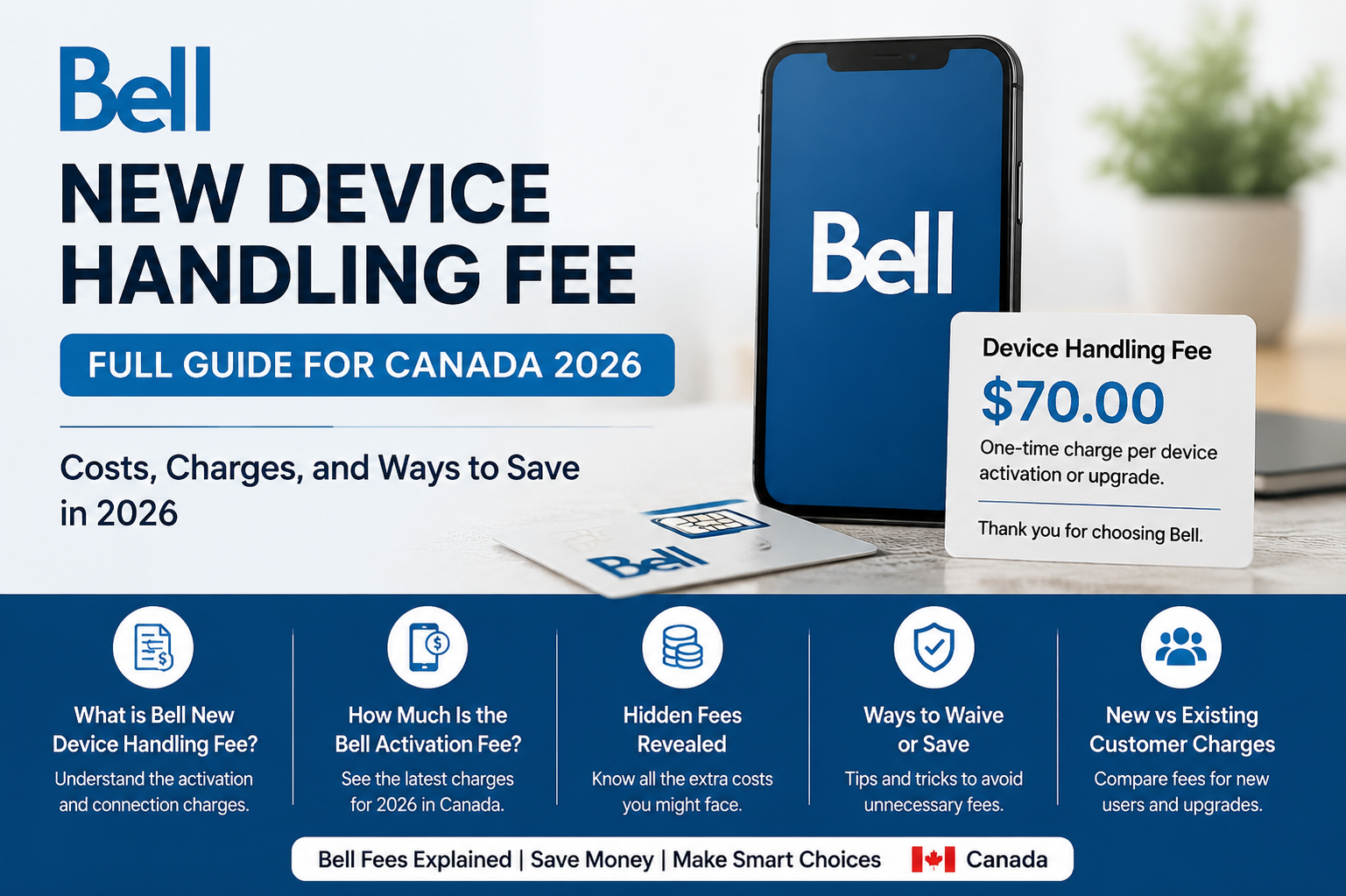
The Bell new device handling fee is a one-time charge applied when a customer activates a new device on the Bell Mobility network. It goes by several names depending on context — you may see it labeled as a Bell activation fee, a Bell connection fee, a Bell service charge new phone entry, or simply a “setup fee” on your first invoice. Regardless of the label, the purpose is broadly the same: Bell charges you for the administrative and logistical process of connecting a new device to their network.
According to Bell‘s publicly available fee disclosures and customer service documentation, this charge covers the provisioning of your SIM card, the activation of your account profile on Bell‘s backend systems, device registration on the network, and in some cases, in-store staff time associated with setting up your phone. Essentially, Bell is charging for the infrastructure and human effort involved in getting your phone from “box in hand” to “fully connected to Canada’s largest LTE and 5G network.”
For many customers, this explanation feels unsatisfying. After all, you are already paying a monthly plan fee, possibly financing a device at full retail price, and in many cases signing a 24-month commitment. The notion that there is an additional charge layered on top of all of that understandably raises eyebrows.
How This Fee Differs From Other Bell Charges
It is important to distinguish the Bell activation fee vs setup fee difference Canada customers sometimes encounter. While both terms are used loosely, there is a technical distinction worth understanding.
The activation fee is primarily associated with new account creation — it applies when a completely new customer joins Bell Mobility and gets a new phone number or ports a number from another carrier. The setup fee or device handling fee, on the other hand, can also apply to existing Bell customers who are upgrading their device. So if you are two years into a Bell plan and you walk into a Bell store to get a new phone, you may encounter the Bell upgrade fee mobile charge even though your account has been active for years.
The Bell SIM card activation fee is a closely related but technically separate charge that some customers see when they replace a SIM card or activate an eSIM — particularly relevant as more Canadians move to eSIM-based iPhones and Google Pixel devices.
Understanding these distinctions matters because each charge may have a different waiver policy, refund eligibility, and negotiation pathway.
How Much Is the Bell Device Handling Fee in 2026?
Current Fee Amounts Across Different Scenarios
One of the most common questions Canadians type into Google is: how much is Bell connection fee for new phone plan? The honest answer is that the exact amount varies based on several factors, but here is the current landscape based on Bell‘s published rates and widely reported customer experiences heading into 2026.
For new postpaid activations at a Bell retail store or through Bell‘s website, the Bell mobility setup fee typically ranges between $45 and $55 CAD. This is the standard activation fee applied to new consumer accounts on a 24-month plan. For customers who activate online directly through Bell.ca without visiting a store, this fee has historically been lower — sometimes reduced to $25 to $35 CAD — reflecting the self-service nature of the transaction and lower operational cost to Bell.
For existing Bell customers processing a device upgrade, the Bell device upgrade charges Canada can be slightly lower, typically in the $35 to $50 CAD range, though this is not guaranteed and may vary by location, promotion, and the specific plan tier involved.
Prepaid customers face a different structure. The Bell service setup charges for prepaid vs postpaid differ meaningfully: prepaid activations often carry a lower flat fee, sometimes as low as $10 to $20 CAD, because the administrative overhead is lighter and no credit check or contract processing is involved.
Why the Fee Varies by Channel
One practical insight that budget-conscious consumers often miss is that Bell telecom fees — including handling and activation charges — are not always uniform across purchase channels. Activating in a Bell corporate store, a Bell authorized dealer (like a mall kiosk), Best Buy, or directly online through Bell.ca can each yield a different fee amount. Authorized dealers sometimes add their own handling charges on top of Bell‘s standard fees, which is a key contributor to Bell hidden charges when buying a new device Canada that consumers report online.
When comparing the Bell new phone activation fee for iPhone and Android specifically, there is generally no difference based on device brand — the fee is tied to the account and plan type, not the specific handset. However, promotional periods around major iPhone launch cycles or Android flagship releases sometimes include waived or reduced activation fees as an incentive, which we will cover in detail later.
Why Does Bell Charge a Device Handling Fee?
The Business Rationale Behind the Charge
Understanding why Bell charges a device handling fee requires stepping back and looking at the Canadian telecom industry as a whole. Canada has one of the most concentrated wireless markets among developed nations, with Bell, Rogers, and Telus collectively dominating the landscape. Within this oligopolistic structure, carriers have historically used fees — both transparent and less visible — as revenue levers that supplement plan pricing without appearing to raise headline monthly rates.
From Bell‘s perspective, the handling fee is a legitimate cost recovery mechanism. Activating a device involves real backend work: provisioning the IMEI number on the network, configuring the account in their billing system, conducting fraud checks, processing number portability requests if the customer is switching from Rogers or Telus, and supporting in-store or phone-based customer service interactions. These are not trivial processes — Bell‘s network infrastructure and billing platforms are complex, regulated environments.
That said, critics — including Canadian consumer advocacy organizations and the CRTC itself — have noted that the fees charged often exceed the reasonable cost of the services described. When a carrier charges $50 for an activation that takes minutes to complete online through an automated system, the excess revenue flows directly to the carrier’s bottom line.
The Competitive Context: Bell vs Rogers vs Telus
A comparison helps put Bell wireless activation cost in context. As of 2026, Rogers and Telus charge broadly similar activation fees in the $35 to $55 range for new postpaid activations, making this largely an industry-wide practice rather than a Bell-specific policy. Budget carriers like Public Mobile (owned by Telus), Lucky Mobile (owned by Bell), and Freedom Mobile have historically charged lower or no activation fees, using that difference as a competitive selling point to attract price-sensitive customers.
This competitive context matters when you are deciding whether to switch carriers. If you are coming from Rogers or Telus to Bell hoping to escape activation fees, you may find the grass is equally fee-laden on the other side.
Is the Bell New Device Handling Fee Refundable?
Refund Policy Explained
Is Bell new device handling fee refundable or not? This is one of the most practically important questions a new customer can ask, and the answer is nuanced.
Bell‘s standard policy, as outlined in their service agreement terms, is that activation and handling fees are non-refundable once the service has been activated. This means that the moment your SIM card is provisioned and your device connects to the Bell network, the fee is considered earned and will not be returned — even if you cancel your plan within a few days.
However, there is an important exception tied to Bell‘s return policy for devices. Bell offers a 15-day satisfaction guarantee on new device purchases made through Bell retail channels. If you return your device within this window and cancel your service, Bell may waive or refund the handling fee as part of the full transaction reversal, though this is at Bell‘s discretion and customer service agents have been reported to handle these requests inconsistently.
For customers who believe they were charged a fee that was not disclosed at the time of purchase — a situation that does arise, particularly through third-party authorized dealers — there is a stronger grounds for requesting a refund. Canada’s wireless code, administered by the CRTC, requires that all fees be clearly disclosed before a contract is signed. If you were not informed of the handling fee before activation, you have a legitimate basis to escalate your complaint to Bell‘s customer relations team and, if needed, to the Commission for Complaints for Telecom-Television Services (CCTS).
How to Avoid or Reduce the Bell Activation Fee
Proven Strategies for Canadian Consumers
The question most readers care about most is this: how to avoid Bell activation fee for new phone. The good news is that there are several practical approaches, and many Canadian customers successfully reduce or eliminate this charge every year.
Activate online instead of in-store. Bell‘s digital channels — Bell.ca and the MyBell app — frequently offer reduced or waived activation fees for customers who complete the process themselves without store assistance. This self-service discount has been a recurring promotion and reflects Bell‘s push toward digital engagement. Check Bell.ca’s current promotions page before visiting a store.
Negotiate directly with customer retention. This is one of the most effective ways to waive Bell device handling fee Canada customers use. If you are an existing Bell customer upgrading your device, call Bell‘s customer retention line (not general customer service) and ask directly whether the upgrade fee can be waived. Long-term customers with clean payment histories have significant leverage here. Retention agents have discretionary authority to apply credits and fee waivers that front-line agents do not.
Watch for promotional periods. Bell regularly runs promotions — particularly in September and October around new iPhone launches, during Boxing Week, and occasionally in back-to-school periods — where activation fees are waived entirely for new or upgrading customers. These promotions are time-limited and sometimes available only on specific plans or device tiers, so it pays to monitor Bell‘s promotional page and comparison sites like MobileSyrup.
Use an authorized dealer strategically. While some authorized dealers add their own fees, others — particularly online dealers and big-box retailers — run their own activation fee promotions independent of Bell corporate. Best Buy Canada and Costco, for instance, have periodically offered Bell plans with no activation fee as part of bundle deals. This is worth checking if you plan to purchase a device anyway.
Port your number and ask for a credit. When switching from Rogers or Telus to Bell, you are a high-value acquisition. Use that leverage. Tell the Bell sales representative or retention agent that you are considering the switch but the activation fee is a barrier. Many agents are authorized to apply a promotional credit to offset the fee for customers porting in from a competitor.
Bell Mobility Connection Fee: A Breakdown for New Customers
What New Customers Should Expect on Their First Bill
Bell mobility connection fee explained for new customers involves understanding that your first Bell bill will almost certainly be higher than your ongoing monthly charges. This is a combination of factors: the activation or handling fee itself, a prorated charge for the days remaining in your first billing cycle from the date of activation, your full second month of service billed in advance (Bell bills one month ahead), and any applicable taxes.
So if your monthly plan is $65/month and you activated mid-cycle, your first bill could easily exceed $150 to $175 once the handling fee, prorated days, advance billing, and HST or GST are factored in. New customers who are not prepared for this often experience genuine sticker shock.
To avoid this surprise, ask Bell to clearly walk you through your first bill estimate before you activate. Request a written or on-screen breakdown that itemizes the Bell telecom fees breakdown for new customers 2026 — including the handling fee, prorated charges, advance charges, and applicable taxes. This is your right under Canada’s wireless code.
Bell New Phone Activation Fee for iPhone vs Android Users
As noted earlier, the Bell new phone activation fee for iPhone and Android is not differentiated by device brand. A customer activating a Samsung Galaxy S25 Ultra pays the same handling fee structure as someone activating an iPhone 17. What can differ is the promotional context: major iPhone launches often coincide with Bell promotions that include waived or reduced fees, while equivalent promotions for Android flagships may be less prominent or shorter in duration.
Bell Upgrade Fee: What Existing Customers Need to Know
The Often-Overlooked Renewal Cost
Long-time Bell subscribers sometimes assume that renewing their contract or upgrading their device is a purely administrative process that comes at no additional cost beyond the new device price. The Bell upgrade fee policy and conditions explained tells a different story.
When an existing Bell Mobility customer upgrades to a new device — particularly on a new 24-month term — Bell typically charges a device upgrade or handling fee. The Bell wireless upgrade fee cost for existing customers generally falls in the $35 to $50 range, though it can sometimes be waived during promotional periods or through negotiation with the retention team.
The rationale Bell provides is that an upgrade involves the same provisioning work as a new activation: a new device IMEI is registered on the network, potentially a new SIM card is issued, and the account terms are reset with updated plan information. From an administrative standpoint, Bell treats this as a triggering event for the fee.
Existing customers who upgrade online through MyBell rather than in-store may access a reduced upgrade fee, mirroring the discount available to new customers who self-activate digitally.
- The Bell new device handling fee is a one-time charge applied during new activations and device upgrades, typically ranging from $35 to $55 CAD for postpaid plans in 2026.
- The fee covers network provisioning, SIM activation, and account setup — but critics argue it often exceeds actual costs.
- Bell SIM activation charges Canada and upgrade fees are related but technically distinct charges; understanding the difference helps you negotiate effectively.
- The fee is generally non-refundable once service is activated, with limited exceptions during Bell‘s 15-day device return window.
- Activating online, negotiating with Bell‘s retention team, and timing your purchase around promotions are the most effective ways to reduce or eliminate this charge.
- Your first Bell bill will be significantly higher than your ongoing monthly rate due to the handling fee, prorated charges, and advance billing — plan accordingly.
- Canada’s wireless code requires full fee disclosure before contract signing; if you were not informed, you have grounds for a CCTS complaint.
- Budget carriers under Bell‘s umbrella (such as Lucky Mobile) offer lower or no activation fees for cost-sensitive customers.
Conclusion: Take Control of Your Bell Fees Before You Sign
The Bell new device handling fee is not going away anytime soon. As long as the Canadian telecom market remains as consolidated as it is, fees like this will continue to be part of the activation experience at Bell, Rogers, and Telus alike. But knowing what you are facing before you walk into a store or click “confirm” on Bell.ca puts you in a fundamentally stronger position than the average consumer.
You now know what the fee is, why it exists, how much it typically costs in 2026, whether it can be refunded, and — most importantly — how to push back against it. Whether you negotiate with retention, time your activation during a promotional window, or simply activate online to access the self-service discount, the strategies in this guide have helped thousands of Canadian customers save real money on a charge that too many people simply accept without question.
If this article helped you, share it with someone who is about to sign up for Bell — chances are they have no idea this fee is coming. And if you have personal experience navigating Bell‘s activation or handling fees, drop your story in the comments. Your insight could save the next reader a meaningful amount on their first bill.
Frequently Asked Questions (FAQs)
1. What is the Bell new device handling fee in Canada 2026? The Bell new device handling fee is a one-time charge — typically $35 to $55 CAD — applied when a customer activates a new device or upgrades an existing device on Bell‘s Mobility network. It covers network provisioning, SIM card activation, and account setup processes.
2. How do I avoid the Bell activation fee for a new phone? The most effective methods include activating online through Bell.ca (which often carries a reduced fee), negotiating with Bell‘s customer retention team, timing your purchase during promotional periods like Boxing Week or iPhone launch events, and checking deals at authorized retailers like Best Buy or Costco.
3. Is the Bell activation fee different from the device handling fee? Yes, though they are related. The activation fee specifically refers to new account creation, while the device handling fee can apply to both new activations and existing customer upgrades. Both are one-time charges for provisioning and account setup.
4. Is Bell‘s new device handling fee refundable? Generally no — the fee is non-refundable once your device is activated and connected to the Bell network. However, if you return your device within Bell‘s 15-day satisfaction guarantee window, you may be able to request a reversal of the charge as part of the full transaction cancellation.
5. How much does Bell charge existing customers for a device upgrade? Existing Bell customers typically pay a Bell upgrade fee of $35 to $50 CAD when upgrading to a new device on a new 24-month term. This can sometimes be waived through the retention team or during promotional periods.
6. Why does Bell charge a device handling fee at all? Bell states the fee covers the cost of provisioning your device on their network, processing your account, conducting fraud checks, and handling SIM card activation. Consumer advocates argue the fee often exceeds the actual cost of these processes.
7. Does Bell charge an activation fee for prepaid plans? Yes, but the Bell service setup charges for prepaid vs postpaid differ. Prepaid activations typically carry a lower fee — often $10 to $20 CAD — reflecting the lighter administrative process involved.
8. Are Bell‘s activation fees higher or lower than Rogers and Telus? They are broadly comparable. All three major Canadian carriers charge $35 to $55 for postpaid activations. The real fee advantages are found with budget carriers like Lucky Mobile, Public Mobile, or Freedom Mobile.
9. What happens if Bell did not disclose the handling fee before I signed? If the fee was not disclosed before you agreed to the service contract, you have grounds for a complaint. Canada’s wireless code requires full disclosure of all fees before contract signing. You can escalate to Bell‘s customer relations team or file a complaint with the CCTS (Commission for Complaints for Telecom-Television Services).
10. Can I waive the Bell SIM card activation fee when switching to eSIM? Some customers have successfully waived the SIM activation fee when switching to eSIM by requesting it through Bell‘s online self-serve tools or by speaking directly with a retention agent. There is no guaranteed waiver, but it is worth asking explicitly before completing the eSIM transfer.