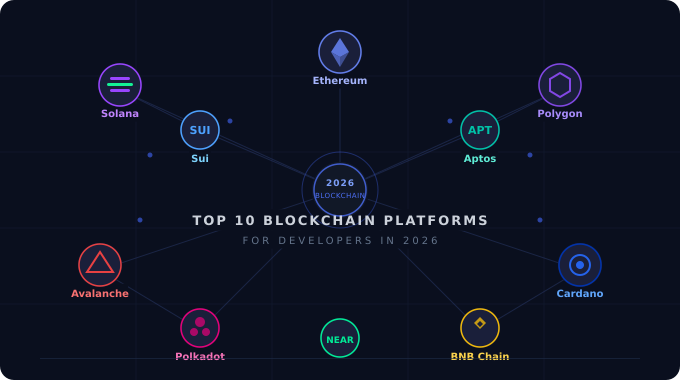
Top 10 Blockchain Platforms for Developers in 2026: The Complete Guide
Why Your Choice of Blockchain Platform Matters
The blockchain ecosystem has matured dramatically. In 2026, developers are no longer choosing between “Web3 exists” and “Web3 doesn’t.” They’re choosing between ecosystems — each with distinct trade-offs in speed, security, decentralization, tooling, and community support.
The best blockchain platforms aren’t just ledgers. They’re developer environments with SDKs, grant programs, documentation quality, liquidity depth, and user bases that determine whether your project lives or dies. This guide breaks down the top 10 platforms you should consider, with a deep focus on what each one means for you as a builder.
1. Ethereum — The Bedrock of Decentralized Development
Best for: DeFi, DAOs, enterprise dApps, high-security smart contracts
Ethereum remains the undisputed foundation of the blockchain developer world in 2026. Launched in 2015 by Vitalik Buterin, Ethereum introduced the concept of programmable smart contracts — and years later, nothing has fully displaced it as the trust layer of the decentralized web.
Key Specs
- Consensus: Proof of Stake (since The Merge, 2022)
- Smart Contract Language: Solidity, Vyper
- TPS: ~15–30 on mainnet; thousands via L2 rollups
- Native Token: ETH
Why Developers Choose Ethereum
Ethereum’s biggest advantage is its network effect. It hosts the deepest liquidity pools, the most audited protocols, and the most battle-tested smart contract infrastructure on the planet. Tens of thousands of developers have written Solidity. Every major security auditing firm knows Ethereum’s quirks.
The EVM (Ethereum Virtual Machine) has become a de facto standard — so much so that most competing platforms now offer EVM compatibility just to attract Ethereum developers.
In 2026, Ethereum’s developer story is heavily tied to Layer 2 solutions. Most production dApps are deployed on L2 networks (Arbitrum, Optimism, Base) for gas efficiency, while Ethereum mainnet serves as the settlement and security layer.
Developer Experience
- Tooling: Hardhat, Foundry, Truffle, Remix IDE
- Libraries: ethers.js, viem, web3.js
- Testing: Extensive; forking mainnet for local testing is standard practice
- Documentation: Best-in-class; years of Stack Overflow answers, audits, and tutorials
Weaknesses
- High gas fees on mainnet during congestion
- Solidity has a learning curve and historical vulnerability surface (reentrancy, overflow)
- Slower innovation cycle compared to newer chains
Verdict: If you want maximum composability, security, and ecosystem access, Ethereum is still the starting point. You build with Ethereum even when you deploy elsewhere.
2. Solana — Speed, Scale, and a Resurgent Ecosystem
Best for: High-frequency trading, gaming, consumer apps, memecoins, NFTs
Solana was written off after the FTX collapse in 2022. By 2026, it has staged one of the most remarkable comebacks in crypto history, reclaiming its position as the go-to platform for high-performance, consumer-facing blockchain applications.
Key Specs
- Consensus: Proof of History + Proof of Stake (Tower BFT)
- Smart Contract Language: Rust (primary), C, C++
- TPS: 65,000+ theoretical; 2,000–5,000 sustained in production
- Native Token: SOL
Why Developers Choose Solana
Speed and cost. Transactions on Solana finalize in under 400 milliseconds and cost fractions of a cent. For applications where user experience demands near-instant feedback — gaming, order books, social apps — Solana’s architecture is simply better suited than slower chains.
The Solana ecosystem in 2026 is vibrant. The Firedancer validator client (developed by Jump Crypto) has significantly improved network stability, addressing one of the biggest historical criticisms. Jupiter, Raydium, and Drift have built some of the most sophisticated DeFi primitives in the space.
The NFT and consumer culture on Solana is unmatched — Tensor, Magic Eden, and a thriving creator economy attract builders who want real users, not just liquidity miners.
Developer Experience
- Framework: Anchor (the dominant smart contract framework)
- Language: Rust — steeper learning curve, but safer memory model
- CLI & Tooling: Solana CLI, Solana Playground (browser IDE), Amman for local testing
- Documentation: Improved significantly; Solana Cookbook is an excellent reference
Weaknesses
- Rust is harder to learn than Solidity
- Network outages, while less frequent, still occur
- Account model is more complex than EVM’s contract model
Verdict: If you’re building a consumer app where UX is everything, Solana is a top-tier choice in 2026. The ecosystem is back — and arguably stronger than ever.
3. Polygon — The EVM Developer’s Scaling Swiss Army Knife
Best for: Enterprise blockchain, gaming, EVM-compatible L2 development, ZK applications
Polygon has evolved from a simple Ethereum sidechain into one of the most comprehensive blockchain scaling ecosystems in existence. In 2026, Polygon’s suite of products gives developers more on-ramps than almost any other platform.
Key Specs
- Consensus: PoS chain + ZK-based L2s (Polygon zkEVM)
- Smart Contract Language: Solidity (EVM-compatible)
- TPS: 7,000+ on PoS; zkEVM scales further
- Native Token: POL (formerly MATIC)
Why Developers Choose Polygon
Polygon’s greatest asset is EVM compatibility with lower costs. Solidity developers can deploy to Polygon PoS with zero code changes. Transactions cost a fraction of Ethereum mainnet. This makes Polygon the default choice for projects that need Ethereum tooling but can’t afford mainnet gas fees.
Beyond the PoS chain, Polygon’s ZK stack is becoming a foundation for enterprise blockchain. Companies like Starbucks, Reddit, and major gaming studios have launched projects on Polygon. The AggLayer — Polygon’s unified liquidity and interoperability layer — is positioning the network to be the connective tissue between different ZK chains.
Developer Experience
- Tools: All standard Ethereum tools work natively
- Polygon SDK: For building application-specific chains
- CDK (Chain Development Kit): Deploy your own ZK-powered L2 in weeks
- Documentation: Excellent; enterprise support available
Weaknesses
- The PoS chain is technically a sidechain, not an L2 — security assumptions differ
- Complex product lineup can be confusing for newcomers
- POL token economics still evolving
Verdict: Polygon is the pragmatic choice — especially for enterprise developers and anyone wanting EVM compatibility at scale without reinventing their stack.
4. Avalanche — Customizable Subnets for the Enterprise World
Best for: Enterprise blockchains, custom L1s (subnets), DeFi, institutional finance
Avalanche has carved out a distinctive niche: it’s the platform enterprises and institutions choose when they want the programmability of Ethereum but need control over their network environment.
Key Specs
- Consensus: Avalanche consensus (novel DAG-based PoS)
- Smart Contract Language: Solidity (EVM-compatible via C-Chain)
- TPS: 4,500+ on C-Chain; subnets can go higher
- Native Token: AVAX
Why Developers Choose Avalanche
The Subnet architecture is Avalanche’s killer feature. A subnet is a custom, sovereign blockchain that runs within the Avalanche ecosystem but can have its own validator set, tokenomics, gas tokens, and virtual machine. This means a bank can run a permissioned subnet for tokenized assets while still interoperating with the broader Avalanche ecosystem.
In 2026, this has attracted serious institutional attention. Evergreen Subnets for financial institutions, gaming-specific subnets (like DFK Chain for DeFi Kingdoms), and enterprise deployments by firms like Deloitte and Deutsche Telekom validate Avalanche’s thesis.
Sub-second finality (~1-2 seconds) and genuine decentralization (no leader-based consensus) make Avalanche technically compelling for high-stakes applications.
Developer Experience
- EVM on C-Chain: Seamless for Ethereum developers
- AvalancheJS / Avalanche-CLI: Good tooling for subnet creation
- Glacier API: Advanced data API for on-chain analytics
- Teleporter: Cross-subnet messaging protocol
Weaknesses
- Subnet liquidity is fragmented; each subnet is its own island
- Validator requirements for subnets can be expensive
- Smaller retail developer mindshare compared to Ethereum or Solana
Verdict: If you need a customizable, high-performance blockchain for enterprise or institutional use, Avalanche’s subnet model is best-in-class. For consumer dApps, it’s solid but faces tougher competition.
5. Cardano — Formal Verification and Academic Rigor
Best for: Research-driven projects, formal verification, emerging market applications, long-term infrastructure
Cardano occupies a unique philosophical position in the blockchain world. Built by IOHK (now IOG) using peer-reviewed research and formal methods, it’s the academic’s blockchain — every feature is published, verified, and debated before deployment.
Key Specs
- Consensus: Ouroboros (Proof of Stake)
- Smart Contract Language: Plutus (Haskell-based), Marlowe (financial contracts), Aiken
- TPS: ~250 on-chain; Hydra Layer 2 enables significant scaling
- Native Token: ADA
Why Developers Choose Cardano
For developers who care about correctness above all else, Cardano’s approach is compelling. The extended UTXO (eUTXO) model makes smart contracts more predictable and auditable than Ethereum’s account model. Transactions are deterministic — you know exactly what a transaction will do before submitting it.
Cardano’s presence in Africa and the developing world is genuinely significant. The Atala PRISM identity system, partnerships with the Ethiopian government for educational credentials, and grassroots adoption in markets underserved by traditional finance give Cardano a real-world mission beyond speculation.
In 2026, the Aiken language has dramatically improved developer ergonomics, and the Hydra head protocol enables off-chain transaction throughput for applications that need it.
Developer Experience
- Aiken: Modern, functional smart contract language — much friendlier than raw Plutus
- Marlowe Playground: Browser-based IDE for financial contract prototyping
- Lucid / Mesh: JavaScript/TypeScript libraries for dApp development
- Documentation: Strong academic resources; community docs improving
Weaknesses
- Smaller DeFi ecosystem; less composability than Ethereum
- Different development paradigm (eUTXO) requires mental shift from EVM
- Slower mainnet evolution compared to some peers
Verdict: Cardano rewards patient, rigorous developers. If you’re building for correctness, regulatory compliance, or emerging market infrastructure, it’s a serious platform — not just an also-ran.
6. Sui — Object-Centric Design for the Next Wave of Apps
Best for: Gaming, social apps, NFTs, high-throughput consumer applications
Sui, developed by Mysten Labs (founded by ex-Meta/Diem engineers), represents one of the most technically innovative Layer 1 blockchains to emerge in recent years. Its object-centric model and the Move programming language give it distinctive advantages for certain classes of applications.
Key Specs
- Consensus: Delegated Proof of Stake + Narwhal/Bullshark DAG
- Smart Contract Language: Move (Sui Move dialect)
- TPS: 120,000+ theoretical; high sustained throughput in practice
- Native Token: SUI
Why Developers Choose Sui
Sui’s object model is its defining innovation. In most blockchains, state is stored in accounts or contracts. In Sui, everything is an object — assets, configurations, NFTs, game items. Objects have owners (addresses, other objects, or are shared). This enables parallel transaction execution: transactions touching different objects can be processed simultaneously, dramatically increasing throughput.
For gaming and NFT applications, this is transformative. A game with millions of players each holding unique items can process thousands of concurrent state changes without bottlenecks. Sui’s sponsored transactions also allow developers to cover gas fees for users — enabling true Web2-like onboarding.
In 2026, Sui has emerged as a leading platform for blockchain gaming and social applications. Projects like Mysten’s own Walrus decentralized storage and a growing DeFi ecosystem (Cetus, DeepBook) are building critical infrastructure.
Developer Experience
- Move Language: Safer than Solidity; resource types prevent common bugs
- Sui CLI + SDK: TypeScript, Rust, Python, Go SDKs available
- Sui Explorer & DevNet/TestNet: Robust testing infrastructure
- zkLogin: Allows users to log in with Google/Apple — a major UX breakthrough
Weaknesses
- Move has a learning curve; smaller talent pool than Solidity
- Still relatively young; ecosystem depth less than Ethereum
- Tokenomics and validator centralization concerns raised by community
Verdict: Sui is one of the most exciting platforms for developers in 2026, particularly for consumer apps and gaming. The technology is genuinely novel, and the developer experience is top-tier.
7. Aptos — Safe, Scalable, and Production-Ready Move
Best for: Enterprise dApps, DeFi, applications requiring high reliability, institutional use cases
Aptos, also born from the ashes of Meta’s Diem project, shares Sui’s Move language heritage but takes a different architectural approach. Where Sui reimagined the object model, Aptos focused on maximizing the safety and performance of a more familiar account-based model.
Key Specs
- Consensus: AptosBFT (HotStuff-based BFT)
- Smart Contract Language: Move (Aptos Move dialect)
- TPS: 160,000+ theoretical; Block-STM enables parallel execution
- Native Token: APT
Why Developers Choose Aptos
Aptos’s Block-STM (Software Transactional Memory) is its core technical differentiator. It enables parallel execution of transactions by optimistically executing them in parallel and resolving conflicts — without requiring developers to explicitly declare object ownership as Sui does. This makes Aptos more familiar for developers coming from account-based blockchains while still achieving high throughput.
Move’s resource-oriented programming model prevents entire categories of vulnerabilities common in Solidity: no reentrancy, no integer overflow, no unauthorized access to resources. For enterprise and institutional builders who need auditable, safe smart contracts, this is a significant draw.
In 2026, Aptos has built strong DeFi infrastructure (Thala, Liquidswap, Aries Markets) and has attracted institutional interest with its strong team and backing. The Aptos Foundation has been active with grants and developer programs.
Developer Experience
- Move Language: Shared with Sui, but different dialect — some transferable knowledge
- Aptos CLI + SDKs: TypeScript, Python, Rust, Go support
- Petra Wallet: Polished user-facing infrastructure
- Aptos Learn: Structured educational resources for Move development
Weaknesses
- Move Aptos and Move Sui are not directly compatible despite shared heritage
- Ecosystem is growing but not yet at Ethereum or Solana depth
- Perception gap: technically strong but lacks the cultural momentum of some rivals
Verdict: Aptos is the safer, more enterprise-oriented counterpart to Sui. If you want Move’s safety guarantees with a more familiar execution model, Aptos is the platform to choose.
8. Polkadot — Interoperability as a First Principle
Best for: Cross-chain applications, parachain development, specialized blockchains that need shared security
Polkadot, created by Ethereum co-founder Gavin Wood and built by Parity Technologies, is architected around a single big idea: that the future of blockchain is not one chain to rule them all, but a network of specialized chains that can communicate securely.
Key Specs
- Consensus: Nominated Proof of Stake (NPoS) + GRANDPA/BABE
- Smart Contract Language: Ink! (Rust-based), Solidity (via EVM parachains)
- TPS: Relay chain + parallel parachain processing
- Native Token: DOT
Why Developers Choose Polkadot
The parachain model is Polkadot’s defining architecture. Parachains are independent blockchains that lease slots on the Polkadot Relay Chain, inheriting its shared security while maintaining their own runtime logic, governance, and tokenomics. Cross-chain communication via XCM (Cross-Consensus Messaging) allows parachains to exchange messages and assets trustlessly.
In 2026, Polkadot 2.0’s coretime model has replaced the slot auction system with a more flexible, market-based approach to acquiring blockspace — lowering the barrier for smaller teams to build application-specific chains. Substrate, Polkadot’s blockchain framework, remains one of the most powerful tools for building custom blockchains from scratch.
Developer Experience
- Substrate Framework: Build a sovereign blockchain with custom pallets (modules)
- Ink!: Rust-based smart contract language for Substrate chains
- Polkadot.js: Comprehensive JavaScript library for chain interaction
- Rust knowledge required for deep Substrate development
Weaknesses
- High complexity; building a parachain is not a weekend project
- DOT tokenomics tied to slot auctions (though evolving with Polkadot 2.0)
- Slower consumer adoption despite technical sophistication
Verdict: Polkadot is for serious infrastructure builders. If your application requires a sovereign blockchain or deep cross-chain communication, the Substrate/Polkadot stack is powerful — just expect a steeper journey.
9. BNB Chain — Developer Accessibility and Massive User Base
Best for: High-traffic consumer dApps, DeFi, gaming, projects needing immediate user access
BNB Chain (formerly Binance Smart Chain) may not be the most decentralized blockchain on this list, but it offers something uniquely valuable: a massive, active user base and extremely low costs.
Key Specs
- Consensus: Proof of Staked Authority (PoSA)
- Smart Contract Language: Solidity (EVM-compatible)
- TPS: 2,000+
- Native Token: BNB
Why Developers Choose BNB Chain
Sheer accessibility. BNB Chain has consistently had some of the highest daily active users of any smart contract platform. Its EVM compatibility means any Ethereum developer can deploy instantly. Gas fees are a fraction of Ethereum mainnet. Binance’s massive exchange ecosystem brings built-in liquidity and user flow.
In 2026, the BNB ecosystem has expanded with opBNB (an OP Stack-based L2) for even cheaper transactions, and BNB Greenfield for decentralized data storage. PancakeSwap remains one of the highest-volume DEXes globally.
For teams that need users on day one — not six months after building community — BNB Chain’s existing ecosystem is hard to ignore.
Weaknesses
- Significantly more centralized than most peers (21 validators)
- Regulatory risk tied to Binance
- Less prestige in developer communities focused on decentralization
Verdict: Pragmatic choice for teams optimizing for user acquisition over decentralization. Not for the ideologically pure, but very real for those chasing volume.
10. Near Protocol — The Sharded Chain with a UX-First Philosophy
Best for: Consumer-facing Web3 apps, social applications, developers prioritizing onboarding UX
Near Protocol rounds out this list as a technically innovative platform that has consistently prioritized developer and user experience above almost everything else.
Key Specs
- Consensus: Nightshade Sharding + Doomslug PoS
- Smart Contract Language: Rust, JavaScript/TypeScript (via JS SDK)
- TPS: 100,000+ (sharded)
- Native Token: NEAR
Why Developers Choose Near
Near’s account model and human-readable addresses are immediately distinctive. Accounts are named (like yourname.near) rather than hex strings. Wallets can be recovered with email. Meta-transactions allow gas fees to be paid on behalf of users.
For consumer apps where onboarding friction kills conversion, these UX innovations matter enormously. Near’s Chain Abstraction vision — allowing users to interact with any blockchain from a Near account — is one of the most ambitious UX roadmaps in the space.
The FastAuth system enables Web2-style login flows (email + biometrics) that abstract away seed phrases entirely, making Near one of the most accessible platforms for mainstream users.
Developer Experience
- JavaScript SDK: Write smart contracts in TypeScript/JavaScript — radical accessibility
- Rust SDK: For performance-critical contracts
- NEAR CLI & Sandbox: Excellent local development environment
- Pagoda/NEAR Developer Console: Integrated tooling dashboard
Weaknesses
- Smaller DeFi liquidity compared to Ethereum, Solana
- Chain Abstraction vision is still maturing
- Less developer mindshare than top-tier chains despite strong technology
Verdict: If you’re building a consumer app and care deeply about onboarding UX, Near’s developer experience and user-facing tools are best-in-class. Its chain abstraction bet could pay off massively.
Comparison Table: Best Blockchain Platforms at a Glance
| Platform | Language | TPS | Fees | EVM? | Best For |
|---|---|---|---|---|---|
| Ethereum | Solidity | ~15-30 (L1) | High (L1) / Low (L2) | ✅ Native | DeFi, security, composability |
| Solana | Rust | 2,000–5,000 | Very low | ❌ | Consumer apps, gaming, NFTs |
| Polygon | Solidity | 7,000+ | Very low | ✅ | EVM scaling, enterprise, ZK |
| Avalanche | Solidity | 4,500+ | Low | ✅ | Enterprise subnets, institutions |
| Cardano | Aiken/Plutus | ~250 | Low | ❌ | Formal verification, emerging markets |
| Sui | Move (Sui) | 120,000+ | Very low | ❌ | Gaming, social, NFTs |
| Aptos | Move (Aptos) | 160,000+ | Very low | ❌ | Enterprise DeFi, safe smart contracts |
| Polkadot | Ink!/Rust | High (parallel) | Variable | Partial | Cross-chain, sovereign chains |
| BNB Chain | Solidity | 2,000+ | Very low | ✅ | High-traffic consumer apps |
| Near | Rust/JS | 100,000+ | Very low | Partial | Consumer UX, chain abstraction |
How to Choose the Right Blockchain Platform in 2026
With ten strong options, the decision comes down to your specific priorities:
- Choose Ethereum if security, composability, and ecosystem depth are non-negotiable. Almost all major DeFi protocols and institutional bridges run here.
- Choose Solana if you need raw speed for a consumer product and want to tap into the most active retail crypto community outside of Ethereum.
- Choose Polygon if you’re an EVM developer who wants low-cost deployment with enterprise credibility and a growing ZK stack.
- Choose Avalanche if you need a customizable subnet for an enterprise or institutional use case, or want sub-second finality with EVM compatibility.
- Choose Cardano if correctness, formal verification, and mission-driven development (especially in emerging markets) align with your project’s values.
- Choose Sui if you’re building a game, social app, or NFT platform and want the most technically innovative, high-throughput architecture with great UX primitives.
- Choose Aptos if you want Move’s safety in a more familiar account-based model, with enterprise-grade reliability and strong institutional backing.
- Choose Polkadot if you need to build a sovereign, application-specific blockchain with cross-chain communication baked in from day one.
- Choose BNB Chain if you need the largest possible user base immediately, EVM compatibility, and rock-bottom fees — and centralization trade-offs are acceptable.
- Choose Near if you’re building a consumer app where Web2-like onboarding and chain abstraction are critical to your go-to-market strategy.
Final Thoughts
The best blockchain platforms in 2026 aren’t competing on the same axis anymore. Ethereum owns the trust layer. Solana owns consumer speed. Polygon and Avalanche are fighting for the enterprise. Sui and Aptos are defining what next-generation execution looks like. Cardano is building for the long game. Polkadot is reimagining how blockchains connect. Near is making Web3 feel like Web2.
The right question isn’t “which blockchain is best?” — it’s “which blockchain is best for what I’m building, for whom, and with what constraints?”
Study the trade-offs. Build on testnets. Talk to the communities. And ship.