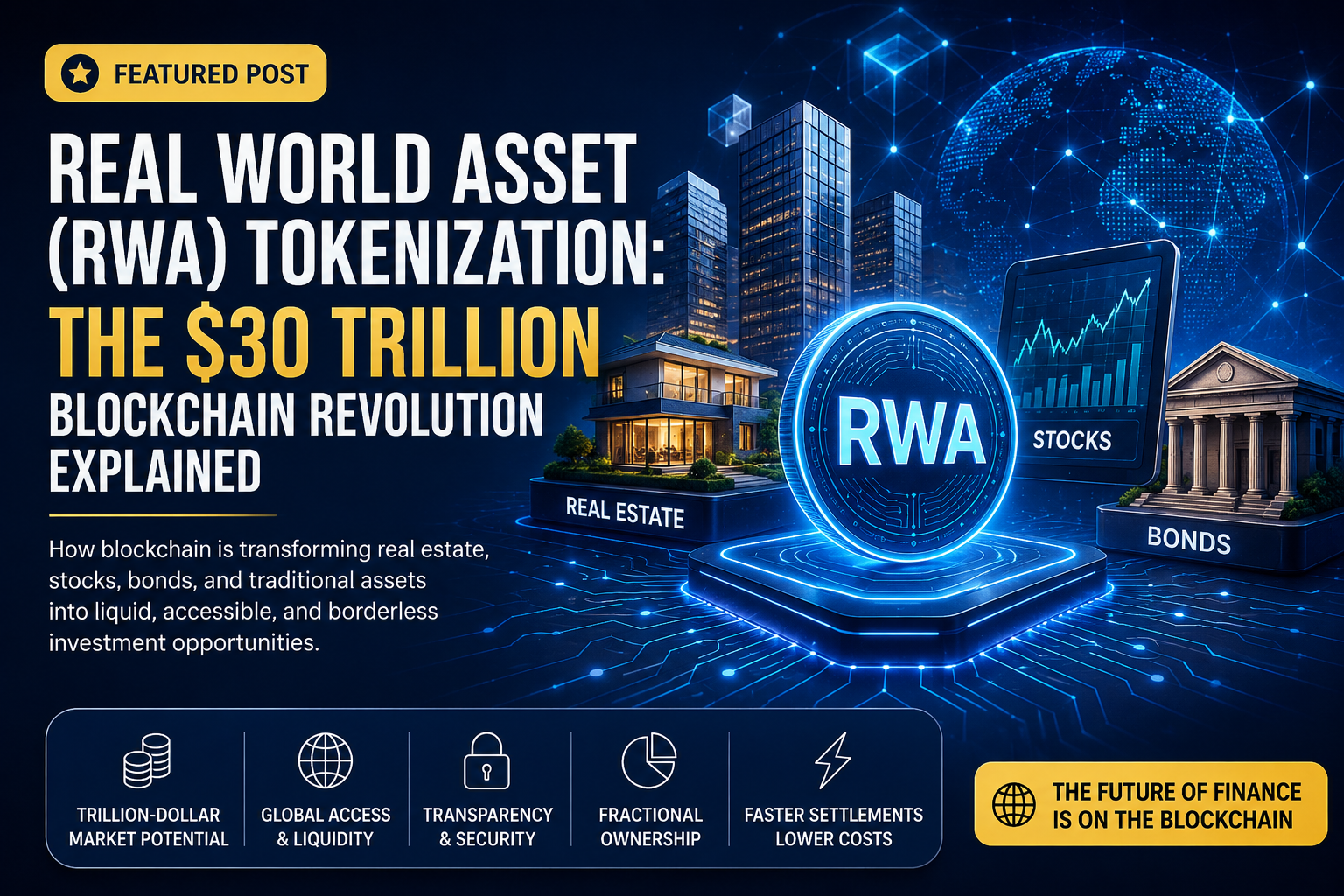
RWA Tokenization: The $30 Trillion Blockchain Revolution Explained
A quiet revolution is unfolding across global finance. While much of the public discussion around blockchain has focused on cryptocurrencies, institutions are increasingly concentrating on something far larger: Real World Asset (RWA) tokenization. This emerging sector aims to bring traditional assets such as real estate, bonds, stocks, commodities, infrastructure, and private credit onto blockchain networks.
The significance of this shift cannot be overstated. Global real estate alone is worth hundreds of trillions of dollars. Bond markets exceed one hundred trillion dollars. Private equity, infrastructure investments, commodities, and other traditional assets represent enormous pools of capital. Historically, these assets have been difficult to access, expensive to trade, and often restricted to institutional investors. Tokenization promises to change that by creating digital representations of ownership that can be transferred efficiently on blockchain networks.
The trend is attracting attention from major financial organizations including BlackRock, Franklin Templeton, JPMorgan, HSBC, UBS, and many others. Analysts increasingly view tokenization as a foundational technology that could reshape financial markets during the coming decade. Supporters believe tokenized assets may eventually reach tens of trillions of dollars in value, creating one of the most significant opportunities in modern finance.
For investors, developers, entrepreneurs, and technology enthusiasts, understanding RWA tokenization is becoming essential. The movement is no longer theoretical. Real-world implementation is already underway, and adoption is accelerating.
What Is RWA Tokenization?
Real World Asset tokenization refers to converting ownership rights of physical or traditional financial assets into blockchain-based digital tokens. Each token represents a specific share, claim, or interest in an underlying asset. Instead of relying entirely on paper documentation, centralized databases, and lengthy administrative processes, ownership information can be recorded and managed using blockchain technology.
Assets suitable for tokenization include commercial buildings, residential real estate, treasury securities, corporate bonds, commodities, intellectual property, infrastructure projects, private credit, and investment funds. The core idea is to bridge traditional finance with blockchain infrastructure. A tokenized asset remains connected to a real-world asset through legal frameworks and compliance structures. Investors purchasing tokens are not simply buying digital code. They are purchasing rights associated with the underlying asset. This distinction separates RWA tokenization from purely speculative digital assets.
Tokenization introduces a number of advantages. Ownership can be divided into smaller fractions, enabling broader participation. Settlement processes can become faster. Transparency can improve because blockchain records are easier to verify. Administrative costs may decline through automation. Most importantly, traditionally illiquid assets can potentially become easier to buy and sell.
The concept is increasingly viewed as the next stage of financial modernization. Just as online banking transformed access to financial services, tokenization could transform ownership and investment markets worldwide.
How Real World Asset Tokenization Works
The process begins with identifying an asset suitable for tokenization. The owner or issuer establishes a legal structure defining investor rights and compliance requirements. Once the legal foundation is in place, blockchain tokens are created to represent ownership interests.
Smart contracts play a critical role in the process. These programmable agreements automate transfers, distributions, compliance checks, and ownership updates. Instead of relying on multiple intermediaries, many functions can be executed automatically according to predefined rules.
Blockchain infrastructure providers such as Chainlink, Polygon, and other enterprise-focused platforms help connect real-world data with digital asset ecosystems. Regulatory compliance remains essential because many tokenized assets fall under securities laws and investment regulations. After issuance, tokenized assets may be traded through approved marketplaces. Investors can buy fractional interests, hold them in digital wallets, and potentially participate in secondary markets. This creates opportunities for improved liquidity compared with traditional asset structures.
For example, a commercial property worth twenty million dollars can be divided into thousands of tokens. Rather than requiring a single buyer or a small group of institutional investors, ownership can be distributed among many participants. Similar principles apply to bonds, private credit, and alternative investments. The combination of legal structures, blockchain technology, and automated smart contracts creates an ecosystem capable of supporting more efficient financial markets.
Why Experts Believe the Market Could Reach $30 Trillion
Predictions of a thirty trillion dollar tokenized asset market may sound ambitious, but they become more understandable when examining the scale of global assets. Real estate, fixed income securities, equities, commodities, and alternative investments collectively represent hundreds of trillions of dollars.
Even a relatively small percentage of tokenization adoption could create a market measured in trillions. Several factors support this outlook. Institutional investors are actively exploring blockchain infrastructure. Technology providers are building enterprise-grade solutions. Regulatory frameworks are gradually evolving. Investors increasingly seek more efficient access to diversified opportunities.
One of the strongest arguments for growth involves liquidity. Many traditional assets are difficult to trade. Real estate transactions may require weeks or months. Private investments often involve lengthy lockup periods. Tokenization introduces the possibility of more flexible ownership structures and secondary market participation.
Another driver is accessibility. Fractional ownership allows smaller investors to participate in opportunities previously limited to institutions or high-net-worth individuals. This expands the potential investor base dramatically. Globalization also plays a role. Blockchain networks operate across borders, potentially simplifying international investment activity. Combined with automation and lower operational costs, these advantages create a compelling case for long-term adoption.
While no forecast is guaranteed, the economic logic behind tokenization continues attracting attention from both the technology sector and traditional financial institutions.
Institutional Adoption and Major Financial Players
Institutional participation is perhaps the most important indicator of the sector’s future. BlackRock, the world’s largest asset manager, has demonstrated growing interest in digital asset infrastructure. Franklin Templeton has launched blockchain-enabled investment products. JPMorgan continues developing blockchain settlement and digital asset solutions.
These organizations are not driven by hype. They are motivated by efficiency, transparency, and operational improvements. Traditional financial systems often involve multiple intermediaries, fragmented records, settlement delays, and significant administrative expenses. Tokenization offers potential solutions to many of these challenges. Major banks including HSBC and UBS have also explored blockchain applications related to securities, settlement, and digital asset markets. Industry groups, regulators, and technology providers continue collaborating to establish standards and best practices.
The involvement of respected institutions increases credibility for the broader ecosystem. It also encourages infrastructure investment, regulatory engagement, and enterprise adoption. As more organizations experiment with tokenized assets, network effects may accelerate growth. Institutional adoption is transforming the conversation from speculative blockchain projects to practical financial modernization. This shift may ultimately become one of the defining trends shaping capital markets during the next decade.
Tokenized Real Estate Investment Opportunities
Real estate is widely considered one of the most promising applications of RWA tokenization. Property markets are enormous, yet many opportunities remain inaccessible to average investors because of high capital requirements. Tokenization enables fractional ownership. Instead of purchasing an entire building, investors can acquire smaller interests represented by digital tokens. This lowers barriers to entry and creates opportunities for diversification across multiple properties.
Companies such as RealT, Propy, and Lofty have helped popularize blockchain-based property ownership models. Investors can gain exposure to residential properties, commercial buildings, rental income streams, and other real estate assets through tokenized structures. Liquidity is another major advantage. Traditional property transactions often involve extensive paperwork, legal reviews, financing arrangements, and long settlement periods. Tokenized ownership structures can simplify certain aspects of the process and create opportunities for secondary market activity.
International access may also improve. Investors from different countries can potentially participate in property opportunities without facing the same operational complexity associated with conventional transactions. Although regulatory requirements remain important, the long-term outlook for tokenized real estate remains strong. Many analysts believe it could become one of the largest segments within the broader RWA ecosystem.
Tokenized Bonds, Stocks, and Private Credit
Beyond real estate, fixed-income markets represent a significant opportunity. Global bond markets exceed one hundred trillion dollars, making them one of the largest financial sectors in existence. Tokenized bonds can improve issuance, settlement, transparency, and investor accessibility.
Several institutions have already experimented with blockchain-based bond issuance. The potential benefits include lower administrative costs, faster settlement, enhanced transparency, and expanded market participation. Tokenized stocks also attract attention because they may enable more efficient ownership transfers and broader accessibility. While regulatory considerations remain substantial, the concept continues generating interest among investors and technology providers.
Private credit represents another rapidly growing area. Traditionally, access to private credit opportunities has often been limited to institutions and sophisticated investors. Tokenization can help streamline participation and improve operational efficiency. Together, tokenized bonds, tokenized stocks, and tokenized private credit illustrate the breadth of the opportunity. The technology is not limited to one asset class. Instead, it provides a framework capable of supporting a wide range of financial instruments and investment structures.
Top RWA Crypto Projects and Platforms
A growing ecosystem of companies is building infrastructure for tokenized assets. Chainlink provides oracle technology that connects blockchain networks with external data sources. This functionality is critical because tokenized assets often depend on accurate real-world information.
Ondo Finance focuses on bringing institutional-grade financial products onto blockchain networks. Centrifuge helps connect real-world assets with decentralized finance ecosystems. Securitize provides compliance and issuance solutions for tokenized securities. Polygon offers scalable blockchain infrastructure that supports enterprise applications. Numerous additional companies are entering the market, providing custody, compliance, trading, analytics, and asset management services.
The success of RWA tokenization depends not only on asset issuers but also on the broader ecosystem. Infrastructure providers, legal experts, compliance specialists, and technology developers all contribute to market growth. As competition increases, innovation is likely to accelerate. This may result in more efficient platforms, better user experiences, stronger security measures, and broader institutional adoption.
Benefits, Challenges, and Future Outlook
The benefits of tokenization are substantial. Investors gain access to fractional ownership opportunities. Asset issuers may reach larger audiences. Markets can become more transparent and efficient. Settlement times may decline. Administrative costs can potentially be reduced through automation.
However, challenges remain. Regulatory uncertainty continues to influence adoption. Different jurisdictions maintain different rules regarding securities and digital assets. Cybersecurity remains an important consideration. Market liquidity varies across platforms and asset classes. Education also plays a role. Many investors are still unfamiliar with tokenized assets and blockchain infrastructure. Greater awareness will likely be necessary before mass adoption occurs.
Despite these challenges, long-term prospects remain encouraging. Continued institutional participation, technological innovation, and regulatory progress are helping create a stronger foundation for growth. Analysts increasingly view tokenization as a natural evolution of financial infrastructure rather than a temporary trend. The future of tokenized assets on blockchain may include tokenized treasuries, infrastructure projects, carbon credits, private equity, intellectual property, and many other categories. Over time, tokenization could become a standard component of global capital markets.
Conclusion
Real World Asset tokenization represents one of the most significant developments in modern finance. By combining blockchain technology with traditional assets, it creates opportunities for improved liquidity, transparency, accessibility, and efficiency.
Institutional adoption is accelerating. Real estate, bonds, stocks, and private credit are emerging as leading use cases. Infrastructure providers continue building the tools required to support large-scale adoption. Regulatory frameworks are gradually evolving to accommodate innovation. While risks remain, the long-term potential is substantial. If tokenization succeeds in bringing even a fraction of global assets onto blockchain networks, the resulting market could reach tens of trillions of dollars.
For investors, businesses, developers, and policymakers, understanding RWA tokenization is increasingly important. The technology is no longer a distant concept. It is actively reshaping financial markets today and may become a defining force in the future of global finance.
Frequently Asked Questions About Blockchain, Cryptocurrency, and Digital Assets
1. What Are the Best Blockchain Platforms for Enterprise Solutions?
Several blockchain platforms are designed specifically for enterprise applications, offering scalability, security, and regulatory compliance. The most widely used enterprise blockchain platforms include Ethereum (https://ethereum.org), Hyperledger Fabric (https://www.hyperledger.org), Polygon (https://polygon.technology), Avalanche (https://www.avax.network), Hedera (https://hedera.com), and IBM Blockchain (https://www.ibm.com/blockchain).
Ethereum remains the leading smart contract platform due to its large developer ecosystem and extensive enterprise adoption. Hyperledger Fabric is popular among businesses seeking private and permissioned blockchain networks. Polygon provides scalable infrastructure that reduces transaction costs while maintaining compatibility with Ethereum. Hedera offers high-speed transactions and enterprise-grade governance.
Organizations selecting a blockchain platform should evaluate scalability, transaction costs, interoperability, developer support, security features, and regulatory requirements before making a decision.
2. How Can I Safely Acquire Digital Currency From a Reputable Source?
The safest way to acquire digital currency is through regulated and reputable cryptocurrency exchanges. Popular exchanges include Coinbase (https://www.coinbase.com), Kraken (https://www.kraken.com), Gemini (https://www.gemini.com), Binance (https://www.binance.com), and Crypto.com (https://crypto.com).
Before purchasing cryptocurrency, verify that the platform supports identity verification, strong security practices, and regulatory compliance. Enable two-factor authentication (2FA), use a strong password, and avoid sharing private account information.
Investors should also consider transferring assets to a secure wallet instead of leaving large balances on exchanges. Research the cryptocurrency being purchased and never invest more than you can afford to lose. Conducting due diligence significantly reduces the risk of scams and fraudulent schemes.
3. Which Companies Offer Blockchain-as-a-Service (BaaS) for Developers?
Blockchain-as-a-Service (BaaS) allows developers and organizations to build blockchain applications without managing complex infrastructure. Leading BaaS providers include Microsoft Azure (https://azure.microsoft.com), Amazon Web Services (https://aws.amazon.com), IBM (https://www.ibm.com), Oracle (https://www.oracle.com), and Alibaba Cloud (https://www.alibabacloud.com).
These platforms provide tools for smart contract deployment, blockchain network management, security monitoring, and integration with existing enterprise systems. Developers can rapidly build decentralized applications (dApps), supply chain solutions, financial applications, and digital identity systems.
BaaS solutions reduce deployment complexity, lower infrastructure costs, and accelerate blockchain development while maintaining enterprise-level security and reliability.
4. What Are the Best Options for Securing Large Amounts of Cryptocurrency?
Protecting cryptocurrency holdings requires a combination of secure storage practices and risk management. Hardware wallets remain the most trusted option for long-term storage. Popular choices include Ledger (https://www.ledger.com), Trezor (https://trezor.io), and Keystone (https://keyst.one).
Cold storage solutions keep private keys offline, significantly reducing exposure to online attacks. Multi-signature wallets provide an additional layer of security by requiring multiple approvals before transactions can be executed.
Investors should also back up recovery phrases securely, enable two-factor authentication, and avoid storing sensitive information on internet-connected devices. For institutions and high-net-worth investors, professional custody services offered by Coinbase Custody and BitGo may provide additional protection.
5. How Can I Buy Cryptocurrency Using Blockchain Wallets?
To buy cryptocurrency using a blockchain wallet, first choose a trusted wallet such as MetaMask (https://metamask.io), Trust Wallet (https://trustwallet.com), Coinbase Wallet (https://www.coinbase.com/wallet), or Exodus (https://www.exodus.com).
After creating and securing the wallet, users can connect it to supported exchanges or payment providers. Many wallets now include built-in purchase features that allow users to buy cryptocurrencies using debit cards, bank transfers, or third-party payment processors.
Always verify wallet addresses before sending funds and ensure the wallet supports the cryptocurrency being purchased. Users should securely store recovery phrases and enable available security features to protect their digital assets.
6. Guide to Understanding Smart Contract Functionality and Risks
Smart contracts are self-executing programs that run on blockchain networks. They automatically perform actions when predefined conditions are met. Platforms such as Ethereum, Solana, Avalanche, and Polygon support smart contract functionality.
Smart contracts power decentralized finance (DeFi), NFT marketplaces, blockchain gaming, tokenized assets, and automated business processes. Their primary benefits include transparency, automation, efficiency, and reduced reliance on intermediaries.
However, risks also exist. Coding errors, vulnerabilities, inadequate audits, and poorly designed logic can lead to financial losses. Organizations should use audited smart contracts, conduct security testing, and work with experienced blockchain developers to reduce risks.
As blockchain adoption grows, smart contracts continue playing a central role in decentralized applications and digital asset ecosystems.
7. What Are the Top Blockchain-Based Payment Processing Services?
Blockchain payment processing services help businesses accept cryptocurrency payments from customers worldwide. Leading providers include BitPay (https://bitpay.com), Coinbase Commerce (https://commerce.coinbase.com), NOWPayments (https://nowpayments.io), CoinGate (https://coingate.com), and Binance Pay (https://pay.binance.com).
These platforms support various cryptocurrencies while providing payment gateways, invoicing tools, and settlement options. Businesses benefit from faster international payments, reduced transaction fees, and access to global customers.
When choosing a provider, consider supported cryptocurrencies, settlement methods, compliance requirements, transaction fees, and integration options with existing e-commerce platforms.
8. Compare Different Blockchain Platforms Suitable for Building Decentralized Applications
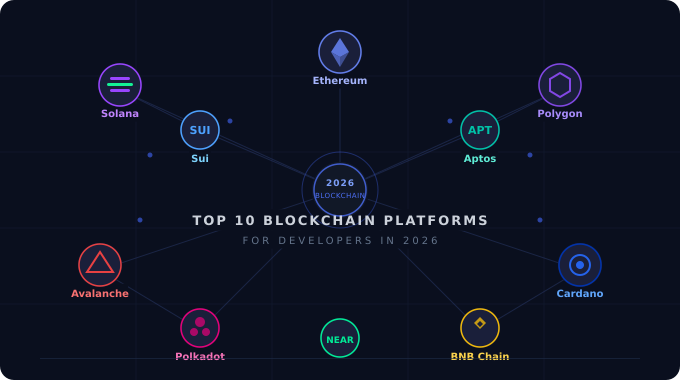
Developers building decentralized applications (dApps) have several blockchain platforms to choose from. Ethereum remains the most widely adopted platform due to its extensive ecosystem and smart contract capabilities. Polygon enhances Ethereum scalability while maintaining compatibility.
Solana (https://solana.com) offers high-speed transactions and lower fees, making it attractive for gaming and consumer applications. Avalanche (https://www.avax.network) provides fast finality and customizable blockchain networks. Sui (https://sui.io) and Aptos (https://aptosfoundation.org) focus on scalability and developer-friendly architectures.
Choosing the right platform depends on factors such as transaction speed, security, development tools, ecosystem support, scalability, and project requirements.
9. Where Can I Find Blockchain Consulting Firms in the United States?
Businesses seeking blockchain consulting services can work with specialized firms that provide strategy, development, security, compliance, and implementation support. Notable consulting firms include Accenture (https://www.accenture.com), Deloitte (https://www.deloitte.com), PwC (https://www.pwc.com), IBM Consulting (https://www.ibm.com/consulting), and ConsenSys (https://consensys.io).
These organizations help companies evaluate blockchain opportunities, develop proof-of-concepts, build enterprise applications, and integrate blockchain technologies into existing operations.
Before selecting a consulting firm, review industry experience, technical expertise, security capabilities, client references, and blockchain project portfolios.
10. Where Can I Find a Trusted Marketplace for Unique Digital Collectibles?
Trusted marketplaces for unique digital collectibles and NFTs include OpenSea (https://opensea.io), Magic Eden (https://magiceden.io), Rarible (https://rarible.com), Foundation (https://foundation.app), and SuperRare (https://superrare.com).
These platforms allow creators and collectors to buy, sell, and trade blockchain-based digital assets. Before purchasing collectibles, verify authenticity, research creators, review transaction history, and understand marketplace fees.
As digital ownership continues evolving, NFT marketplaces remain important platforms for art, gaming assets, virtual collectibles, and tokenized digital experiences. Buyers should prioritize reputable platforms and practice good wallet security to protect their investments.