How to Create an AI Chatbot That Boosts Sales: The Complete Guide for 2026
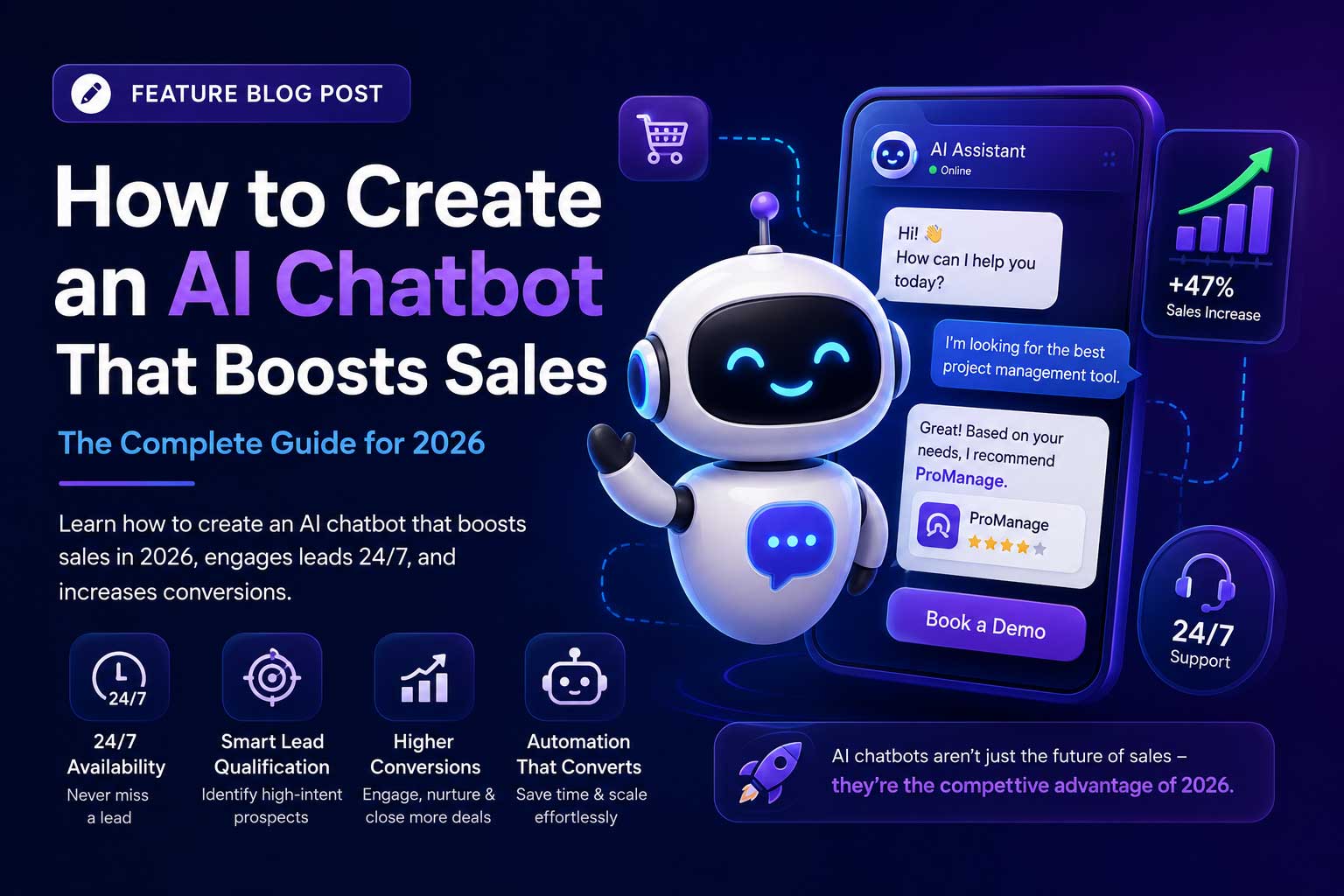
Learn how to create an AI chatbot that boosts sales in 2026, engages leads 24/7, and increases conversions. Step-by-step guide with the latest tools, strategies, and real-world tips.
Why Your Business Needs a Sales AI Chatbot in 2026
Every second a potential customer waits for a response, your conversion rate drops. Studies show that responding to a lead within 5 minutes increases conversion chances by 9x — yet most businesses take hours or even days to follow up.
That’s exactly where an AI chatbot changes the game.
In 2026, AI chatbots have evolved far beyond scripted pop-ups and basic FAQ bots. Today’s AI-powered sales chatbots use large language models (LLMs), voice interaction, real-time personalization, and agentic reasoning to engage customers as naturally as a trained human sales rep — at infinite scale and zero overtime pay.Whether you run an e-commerce store, a SaaS platform, or a service-based business, deploying the right AI chatbot is now one of the highest-ROI investments you can make. In this comprehensive guide, you’ll learn how to create an AI chatbot that boosts sales in 2026, which platforms to use, what features matter most, and how to optimize it for maximum revenue impact.
1. What Is a Sales AI Chatbot?
A sales AI chatbot is a conversational software program powered by artificial intelligence that interacts with website visitors, app users, or social media followers in real time. Unlike the basic rule-based bots of a few years ago, the chatbots of 2026 are powered by advanced large language models (LLMs) that understand nuance, context, and buyer intent with remarkable accuracy.
In a sales context, these bots serve as always-on digital sales assistants that:
- Greet and engage visitors proactively with context-aware messages
- Answer product and pricing questions instantly — even complex, multi-part ones
- Qualify leads based on predefined and AI-inferred criteria
- Recommend products or services based on real-time user behavior and purchase history
- Book demos, appointments, and discovery calls without human involvement
- Follow up with abandoned cart users through chat, email, or WhatsApp
- Upsell and cross-sell at precisely the right moment in the conversation
- Operate across voice, text, and video interfaces simultaneously
In 2026, the line between a chatbot and a virtual sales agent has blurred considerably — and that’s excellent news for your bottom line.
2. How AI Chatbots Boost Sales in 2026
Here’s why AI chatbots have become the most powerful sales tool in the modern business stack:
24/7 Availability Across Every Channel
Your chatbot never sleeps. It captures leads at 2 AM just as effectively as during peak business hours — on your website, WhatsApp, Instagram DMs, SMS, and voice assistants simultaneously. In 2026, omnichannel presence is table stakes, and AI chatbots deliver it effortlessly.
Instant, Intelligent Lead Qualification
By asking smart conversational questions — budget, timeline, company size, current pain points — your bot segments leads in real time and routes high-intent prospects directly to your sales team, while nurturing cooler leads automatically.
Hyper-Personalized Buyer Journeys
2026’s AI chatbots go beyond simple name personalization. They analyze browsing behavior, past purchases, geographic data, and even sentiment signals within the conversation to tailor every response — delivering the right message to the right person at the right moment.
Reduced Cart Abandonment
Triggered chatbot interventions can re-engage users who are about to leave, offering personalized discount codes, answering final objections, or surfacing a timely social proof message — often saving sales that would have been permanently lost.
Agentic Task Completion
The biggest leap in 2026: AI chatbots can now take action, not just answer questions. They can place orders, update account details, initiate refunds, send follow-up emails, and update your CRM — all within the conversation window, without any human involvement.
Scalability Without Extra Headcount
One AI chatbot handles thousands of simultaneous conversations with consistent quality — something no human team can match at any budget. As your traffic scales, your chatbot scales with it automatically.
Faster Sales Cycles
By eliminating friction, delivering instant answers, and proactively addressing objections, chatbots drastically compress the time between first visit and first purchase.
3. Key Features of a High-Converting Sales Chatbot in 2026
Not all chatbots are created equal. Look for these critical features when building or selecting your sales chatbot:
| Feature | Why It Matters in 2026 |
|---|---|
| LLM-Powered NLP | Handles natural, nuanced conversations without rigid scripts |
| Agentic Capabilities | Takes real actions (place orders, update CRM, send emails) autonomously |
| Omnichannel Deployment | Works seamlessly across web, WhatsApp, Instagram, SMS, and voice |
| CRM Integration | Syncs leads and conversation history directly into your pipeline |
| AI Lead Scoring | Uses machine learning to rank lead quality in real time |
| Voice & Multimodal Support | Engages users through text, audio, and image inputs |
| Product Recommendation Engine | Delivers personalized suggestions based on behavior and intent |
| Human Handoff | Escalates to a live agent with full context, at exactly the right moment |
| Sentiment Analysis | Detects frustration or urgency and adjusts tone or escalates accordingly |
| Multilingual Support | Serves global audiences natively in 50+ languages |
| A/B Testing Engine | Continuously optimizes flows for higher conversion |
| GDPR / Privacy Compliance | Handles data ethically in line with 2026 regulations |
4. Top AI Chatbot Platforms to Consider in 2026
The chatbot platform landscape has matured significantly. Here are the top contenders:
Tidio — Best for E-Commerce
Tidio’s Lyro AI has evolved into a powerful LLM-backed sales engine, capable of handling complex product queries, processing returns, and recommending items based on browsing behavior. Native Shopify and WooCommerce integration makes setup seamless.
Best for: E-commerce stores wanting fast deployment and strong out-of-the-box automation.
Drift (now part of Salesloft) — Best for B2B Sales
After merging into the Salesloft revenue platform, Drift’s conversational AI is tightly integrated with deal intelligence and pipeline analytics. It qualifies leads, books meetings, and provides real-time coaching signals to your sales team.
Best for: B2B SaaS and enterprise companies running account-based sales motions.
ManyChat — Best for Social Commerce
ManyChat remains the dominant force for Instagram, WhatsApp, and Facebook automation. Its 2026 AI upgrade enables more natural conversations while its e-commerce integrations make it a powerhouse for DTC brands driving revenue through social content.
Best for: D2C and creator-driven brands selling through social media platforms.
Intercom (with Fin AI) — Best for SaaS & Product-Led Growth
Intercom’s Fin AI agent is now one of the most capable AI chatbots for SaaS companies — handling onboarding, in-app guidance, upsell conversations, and customer success workflows with impressive accuracy.
Best for: SaaS companies focused on activation, upselling, and churn reduction.
Custom LLM-Powered Bots (Claude API / OpenAI API)
For businesses that want total control, building on top of Anthropic’s Claude or OpenAI‘s GPT models offers unmatched flexibility. In 2026, this approach has become more accessible thanks to better tooling, richer APIs, and lower per-token costs.
Best for: Tech-forward businesses with development resources who need a fully tailored, proprietary chatbot solution trained on their exact data.
5. How to Create Your AI Sales Chatbot (Step-by-Step)
Follow this proven 2026 framework to build a chatbot that drives real revenue:
Step 1: Define Your Sales Goals
Before building anything, answer these questions:
- What is the primary objective? (Lead generation, cart recovery, product discovery, demo booking?)
- Who is your target buyer persona?
- What stage of the funnel will the chatbot own?
- What does a “successful conversation” look like — and how will you measure it?
Clear goals determine your conversation architecture, integrations, and KPIs.
Step 2: Map Your Customer Journey
Identify every touchpoint where a chatbot adds value:
- First-time homepage visitor who hasn’t engaged with any content
- Blog reader spending 3+ minutes on a high-intent article
- Pricing page visitor comparing your plans to a competitor
- Cart abandoner who left after seeing the shipping cost
- Returning customer who hasn’t repurchased in 90 days
- Existing user who just hit a usage limit (upsell opportunity)
Each scenario deserves its own tailored conversation flow with a distinct goal.
Step 3: Choose Your Platform or Build Custom
Based on your goals, budget, and technical resources, select a platform from the list above — or build a custom bot using a Claude or OpenAI API integration.
Key decision factors:
- Budget: Platforms range from $15/month (ManyChat) to $2,500+/month (enterprise). Custom builds run $5,000–$100,000+ depending on scope.
- Integrations: Your CRM, e-commerce platform, email tools, and calendar software must connect seamlessly.
- Complexity: No-code builders deploy fast; API-based custom bots take longer but offer full control.
- Compliance: Ensure the platform meets your regional data privacy requirements (GDPR, PDPL, etc.)
Step 4: Design Your Conversation Flows
This is the most important step. Your conversation flows determine whether users engage, convert — or bounce.
Conversation design principles for 2026:
- Open with a context-aware greeting (reference traffic source, page content, or past visits)
- Ask one intelligent question at a time — never overwhelm
- Use quick-reply buttons alongside open text to guide users while maintaining flexibility
- Layer in social proof naturally (“Over 25,000 businesses use us for exactly that”)
- Drive every conversation toward a clear, specific CTA — book a demo, claim a trial, view a product
- Always offer a smooth human handoff when the bot reaches its limits
Example flow for a B2B SaaS product:
Bot: "Hi! 👋 Looks like you're checking out our pricing. Have any questions I can help with?"
→ [Yes, comparing plans] / [Wondering about integrations] / [Just browsing]

If "Yes, comparing plans":
Bot: "Happy to help! How large is your team?"
→ [Just me] / [2–10 people] / [11–50] / [50+]

Based on size → Recommend the right plan + highlight key features + CTA to start free trial or book demo
Step 5: Train Your Chatbot on Your Business
Feed your chatbot with rich, accurate information:
- Full product catalog with descriptions, pricing tiers, and feature comparisons
- Common sales objections and how your team handles them (“Too expensive?” → Show ROI calculator)
- FAQs from your support tickets and sales call recordings
- Brand tone of voice — should the bot be formal, conversational, witty, or warm?
- Competitor comparisons — how you differentiate, handled diplomatically
In 2026, RAG (Retrieval-Augmented Generation) allows your bot to pull answers in real time from your knowledge base, documentation, or CRM — keeping responses accurate even as your business evolves.
Step 6: Integrate with Your Full Tech Stack
Connect your chatbot to:
- CRM (HubSpot, Salesforce, Pipedrive) — leads and conversation summaries auto-sync
- Email marketing (Klaviyo, ActiveCampaign) — trigger nurture sequences based on chat outcomes
- Calendar tools (Calendly, Google Calendar) — book meetings without leaving the chat
- E-commerce platform (Shopify, WooCommerce) — enable order lookup, returns, and product recommendations
- Analytics (GA4, Mixpanel, Heap) — attribute revenue to chatbot interactions accurately
- Customer Data Platform (Segment, Rudderstack) — unify chatbot data with your full customer profile
Step 7: Rigorously Test Before You Launch
Run your chatbot through every realistic scenario:
- Test with actual users, not just your internal team — they know too much
- Check all edge cases: off-topic questions, rude inputs, multi-turn ambiguity
- Verify every integration works end-to-end (does the lead actually show up in HubSpot?)
- Test on mobile — in 2026, over 65% of web interactions happen on mobile devices
- Run adversarial tests to ensure the bot doesn’t produce harmful or off-brand responses
Step 8: Launch, Monitor, and Iterate
Deploy your chatbot and monitor performance intensively in the first two weeks. Watch:
- Engagement rate — What % of visitors start a chat?
- Completion rate — What % reach the intended endpoint?
- Drop-off points — Where do users abandon the flow?
- Human escalation rate — How often does the bot fail to resolve queries?
- Revenue attribution — Which conversations led to actual purchases?
Use this data to run continuous experiments. The best sales chatbots in 2026 are never truly “finished” — they get smarter every week.
6. Best Practices to Maximize Chatbot Sales Performance
Trigger Conversations Based on Behavior, Not Time
Avoid generic “Can I help you?” pop-ups. In 2026, the best chatbots trigger based on meaningful signals:
- Exit intent — User is about to leave without converting
- High scroll depth — User clearly engaged with a long-form product page
- Pricing page dwell time — User has been comparing plans for 45+ seconds
- Return visit — User is back for the third time — they’re interested, just not convinced yet
- Referral source — Visitor came from a specific campaign or competitor comparison page
Make Every Interaction Feel One-on-One
Use the data you already have. “Hi James, you looked at the Enterprise plan last week — want me to walk you through what’s changed since then?” converts exponentially better than a generic greeting. Personalization in 2026 is expected, not impressive.
Use Rich Media and Interactive Elements
Modern chatbots support video demos, product carousels, interactive pricing calculators, and image galleries. A 60-second product demo video embedded mid-conversation can eliminate 10 minutes of back-and-forth.
Offer Chatbot-Exclusive Incentives
“Start a chat and unlock 20% off — for the next 15 minutes only.” Scarcity plus personalization plus zero friction is a powerful conversion formula. Exclusive chatbot offers also give users a tangible reason to engage rather than ignore the widget.
A/B Test Everything, Constantly
Test your opening message. Test button labels. Test the timing of your CTA. Test whether offering a discount upfront or after an objection performs better. Let data, not intuition, guide your optimization.
7. Common Mistakes to Avoid in 2026
- ❌ Sounding like a bot — With LLM-powered chatbots now the norm, robotic language is a red flag that erodes trust immediately. Write flows that sound like your best sales rep on a great day.
- ❌ Over-qualifying and under-engaging — Peppering users with five qualifying questions before offering any value will kill engagement. Lead with value, earn the right to ask questions.
- ❌ No graceful human handoff — Even in 2026, some conversations need a human. If your bot hits a wall and doesn’t escalate smoothly, you lose the sale and the customer’s trust.
- ❌ Ignoring post-chat follow-up — The conversation shouldn’t end when the chat window closes. Trigger automated follow-up sequences based on what was discussed.
- ❌ Neglecting voice and mobile — A significant portion of chatbot interactions now happen via voice interfaces and mobile apps. If your bot isn’t optimized for these, you’re leaving revenue on the table.
- ❌ Set-and-forget deployment — Markets shift, products change, and buyer language evolves. A chatbot trained on 2024 data and never updated will underperform significantly by 2026.
8. Measuring Success: Key Metrics to Track
| Metric | What It Measures | 2026 Benchmark |
|---|---|---|
| Engagement Rate | % of visitors who start a chat | 25–45% |
| Lead Capture Rate | % of chats yielding a qualified lead | 20–35% |
| Conversion Rate | % of chatbot leads becoming customers | 8–18% |
| Average Order Value (AOV) | Revenue per chatbot-assisted purchase | 15–25% above baseline |
| Response Accuracy | % of queries resolved without escalation | >90% |
| Customer Satisfaction (CSAT) | User rating of the chatbot experience | >4.2/5 stars |
| Cost Per Lead (CPL) | Total chatbot cost ÷ leads generated | 40–70% lower than paid ads |
| Revenue Attributed | Direct revenue from chatbot-assisted journeys | Track via UTM + CRM |
9. Real-World Examples of AI Chatbots Driving Sales
Sephora — Beauty Retail
Sephora’s AI chatbot acts as a virtual beauty advisor — recommending products based on skin type, shade matching from uploaded selfies, and booking in-store appointments. The chatbot has driven measurable increases in both online conversion rates and in-store foot traffic from digital touchpoints.
Salesforce + Einstein Bots — Enterprise B2B
Salesforce’s internal deployment of Einstein AI bots across their own sales process — qualifying inbound leads, routing to the right account executive, and prepping reps with conversation intelligence before every call — has compressed average sales cycles significantly.
Klarna — Fintech / E-Commerce
Klarna’s AI assistant handles millions of customer interactions monthly across shopping assistance, payment queries, and dispute resolution. The company reported their AI assistant doing the equivalent work of 700 full-time agents at a fraction of the cost.
Domino’s — Food & Quick Commerce
Domino’s conversational ordering system now spans voice, SMS, smart displays, and messaging apps. The frictionless ordering experience has contributed to consistent growth in digital order volume year over year.
Frequently Asked Questions (FAQ)
Q: How much does it cost to build an AI sales chatbot in 2026? A: Costs have come down significantly. No-code platforms start at $15–$50/month. Mid-market solutions run $200–$1,000/month. Enterprise platforms like Drift or Intercom cost $2,000–$5,000+/month. Custom-built LLM-powered bots typically require a $10,000–$100,000 development investment, with lower ongoing API costs than ever before.
Q: How long does it take to deploy a chatbot? A: A basic no-code bot can go live in 1–3 days. A production-ready, fully integrated chatbot for a mid-size business typically takes 2–6 weeks. An enterprise custom build can take 2–4 months including testing and integration.
Q: Do AI chatbots replace human sales reps in 2026? A: No — but they’ve taken over the repetitive, high-volume parts of the sales funnel. The best sales teams use chatbots to handle top-of-funnel qualification and scheduling, so human reps can focus exclusively on high-value, complex deals that require relationship-building and negotiation.
Q: Can a small business afford an AI chatbot? A: Absolutely. Platforms like ManyChat, Tidio, and Chatfuel offer fully functional AI chatbot plans starting under $30/month — well within reach for any small business. The ROI typically justifies the cost within the first month.
Q: What makes a 2026 chatbot different from older bots? A: Three major differences: (1) LLM-powered language understanding means the bot handles natural, unscripted conversation without breaking; (2) agentic capabilities allow the bot to actually do things, not just answer questions; and (3) multimodal support means bots can now process images, voice, and documents — not just text.
Q: How do I make sure my chatbot stays compliant with data privacy laws? A: Choose a platform with built-in GDPR, CCPA, and regional compliance controls. Ensure your chatbot never stores sensitive data unnecessarily, always surfaces a clear privacy disclosure, and gives users a straightforward opt-out. Work with your legal team to review your bot’s data handling policies before launch.
Conclusion: Conversational AI Is Now Your Top Sales Asset
In 2026, the question is no longer whether to deploy an AI chatbot — it’s whether you’re deploying one that’s good enough to compete.
The businesses winning in this environment aren’t just using chatbots. They’re using intelligent, agentic, personalized chatbots that understand their customers, adapt in real time, and take meaningful action throughout the entire buyer journey.The barrier to entry has never been lower. The potential upside has never been higher. Whether you start with a $30/month no-code platform or invest in a custom LLM-powered solution, every business today has the ability to deploy a chatbot that works smarter than their competition.
Define your goals. Map your customer journey. Build with intention. Optimize relentlessly.
The businesses that master conversational AI in 2026 will compound those advantages for years to come. The ones that don’t will find themselves competing against rivals who never sleep, never miss a lead, and get better every single day.