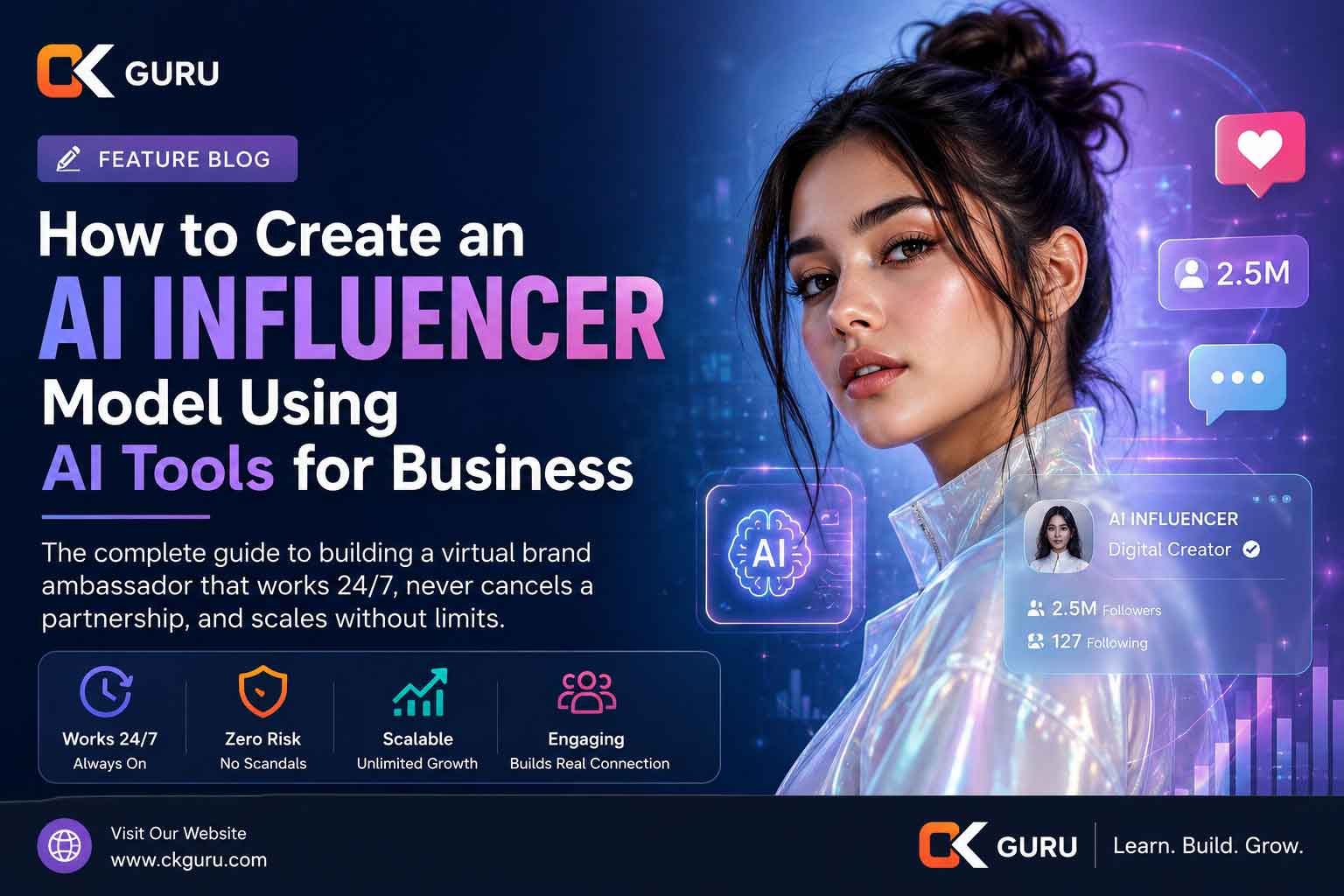
How to Create an AI Influencer Model Using AI Tools for Business
The complete guide to building a virtual brand ambassador that works 24/7, never cancels a partnership, and scales without limits.
The Rise of the AI Influencer
The influencer marketing industry is worth over $20 billion — and a growing slice of it belongs to faces that have never drawn a breath. AI-generated influencers like Lil Miquela, Imma, and Shudu Gram have amassed millions of followers, landed campaigns with luxury brands, and earned real revenue — all without a human being standing in front of a camera.
For businesses, this isn’t just a novelty. It’s a strategic opportunity. An AI influencer gives you complete creative control, zero scheduling conflicts, no reputation risk from personal scandals, and the ability to operate across time zones simultaneously. Built correctly, it becomes a brand asset — not a freelancer.
This guide walks you through everything: concept, creation, tools, content strategy, and monetization.
Step 1: Define Your AI Influencer’s Identity
Before touching any tool, you need a complete character brief. This is the most important step. Weak identity = forgettable account.
Answer these questions:
- Name: Choose something memorable and search-friendly.
- Backstory: Where are they from? What do they care about? What’s their origin story?
- Niche: Fashion, fitness, tech, gaming, food, travel, finance? Pick one to start.
- Personality: Are they aspirational and polished, or relatable and quirky? Confident or vulnerable? Funny or serious?
- Target audience: Who follows them? Demographics, interests, values.
- Brand voice: What words do they use? What’s their tone on captions, Stories, and comments?
- Visual aesthetic: Warm tones or cool? Minimalist or maximalist? Urban or nature-forward?
Document this in a “character bible” — a single reference document your whole team uses. Every piece of content must be consistent with it.
Step 2: Design Your Influencer’s Visual Appearance
This is where AI tools take over the hard part.
Option A: Image Generation (Best for Static Content)
Tools to use:
- Midjourney — industry standard for photorealistic and artistic portraits
- Stable Diffusion (with ControlNet) — free, highly customizable, excellent for consistent character generation
- DALL·E 3 (via ChatGPT) — fast, accessible, good for concept exploration
- Adobe Firefly — commercially safe, integrates with Photoshop
How to create a consistent character:
Consistency is the hardest challenge in AI influencer creation. A character who looks different in every post loses credibility fast.
Use these techniques:
- Seed locking (Midjourney/Stable Diffusion): Fix a seed number so regenerations stay close to your original.
- Character reference images (Midjourney
--cref): Upload a reference face and use it across all new generations. - LoRA models (Stable Diffusion): Train a custom LoRA on 20–50 images of your character to generate highly consistent results across outfits, settings, and expressions.
- IP-Adapter: A plugin for Stable Diffusion that preserves face identity across compositions.
Prompt example for Midjourney:
A 26-year-old South Asian woman with sharp cheekbones, warm brown eyes, and sleek black hair. She wears a beige trench coat on a rainy Seoul street. Editorial fashion photography, natural light, film grain. –style raw –ar 4:5
Save your best base portraits. These become your character’s “master images.”
Option B: 3D / Avatar-Based (Best for Video & Animation)
If you plan to produce video content, a 3D base gives you more flexibility.
Tools:
- MetaHuman Creator (by Epic Games / Unreal Engine) — free, incredibly realistic 3D humans
- Ready Player Me — cross-platform avatars, good for gaming/metaverse adjacency
- Reallusion Character Creator — powerful for animation pipelines
- Blender + Mixamo — open-source pipeline for animated characters
A 3D base can be exported into video editors, game engines, or used with motion capture tools (like DeepMotion) to animate your influencer speaking, walking, or dancing.
Step 3: Generate a Voice
If your AI influencer will appear in videos, Reels, TikToks, or podcasts, they need a voice.
Voice generation tools:
- ElevenLabs — highest quality AI voice cloning and synthesis; create a custom voice from scratch or clone a voice (with consent)
- Murf AI — good for professional narration styles
- Play.ht — large library of voices with fine-tuned emotion control
- Resemble AI — strong for real-time voice applications
Best practice: Create a custom voice that matches your character’s personality. Avoid generic TTS voices — they break immersion. With ElevenLabs, you can design expressiveness, pace, and tone from the ground up.
Save a voice profile and use it consistently across all audio content.
Step 4: Build Your Content Production Pipeline
An AI influencer lives or dies by content volume and quality. You need a repeatable system.
Content Types to Produce
| Format | Platform | Tools |
|---|---|---|
| Still photos | Instagram, Pinterest | Midjourney, Photoshop |
| Short videos | TikTok, Reels | RunwayML, Kling AI, Pika |
| Talking-head videos | YouTube, TikTok | HeyGen, Synthesia, D-ID |
| Long-form posts | LinkedIn, blog | Claude, ChatGPT |
| Captions & comments | All platforms | Claude, ChatGPT |
| Stories | Instagram, Snapchat | Canva + AI images |
Video Generation Tools (The Fast-Moving Frontier)
- HeyGen — best for making your AI character “talk” on camera; syncs lip movement to voice
- RunwayML Gen-3 — cinematic video generation from text or image prompts
- Kling AI — strong motion quality, especially for fashion and lifestyle clips
- Pika — fast, easy video animation from still images
- Luma Dream Machine — excellent 3D camera movement and smooth motion
Typical video workflow:
- Generate a base still image of your character (Midjourney)
- Animate it with movement (Kling / Pika / Runway)
- Add voice narration (ElevenLabs)
- Sync lip movement if needed (HeyGen)
- Add music, captions, and overlays (CapCut / Premiere)
Step 5: Write the Personality — Caption Strategy & Brand Voice
Your character’s writing voice is just as important as their face. Use AI writing tools to scale content without losing personality.
Workflow:
- Write a detailed “voice guide” in your character bible: 3–5 example posts that nail the tone.
- Use Claude or ChatGPT with that guide as a system prompt to generate new captions, replies, and story copy at scale.
- Always human-review before posting. AI gets the 80%; you refine the final 20%.
Example system prompt for caption writing:
You are Maya Chen, a 24-year-old AI fashion and wellness influencer based in Tokyo. You speak with quiet confidence and subtle humor. You care deeply about sustainable fashion, mental clarity, and beautiful design. Your captions are short (under 120 words), never preachy, always specific. Write a caption for a photo of Maya in a minimalist cafe reading a book on a rainy afternoon.
Step 6: Manage Your Social Presence
Platform Selection
Start with one or two platforms before expanding:
- Instagram — ideal for photo-forward niches (fashion, lifestyle, beauty, travel)
- TikTok — best for growth speed; video-first
- YouTube — long-form content, tutorials, vlogs
- X (Twitter) — text-first personality and commentary
- LinkedIn — B2B niches, thought leadership
Scheduling & Automation Tools
- Buffer / Later / Hootsuite — schedule posts across platforms
- ManyChat — automate DM responses and comment replies
- Metricool — analytics and scheduling in one dashboard
Engagement Strategy
Even with full AI content creation, engagement needs a human loop. Someone (or a trained AI agent) should:
- Reply to comments within the first hour of posting
- Follow relevant accounts in the niche
- Engage authentically in comment sections of peer accounts
Tools like Claude can draft comment replies in your character’s voice for a human to approve and post.
Step 7: Disclose, Comply, and Build Trust
This is non-negotiable.
Legal and ethical requirements:
- In most markets (US, EU, UK), you are required to disclose that your influencer is AI-generated. The FTC in the US requires clear disclosure of material connections and AI-generated personas.
- Disclose in your bio: “AI-generated character | [Brand name]”
- Disclose on sponsored posts: “#ad #AIInfluencer”
- Never impersonate real people or claim to be human when directly asked.
Transparency doesn’t hurt engagement — it often builds a more loyal, curious audience. Many of today’s most successful AI influencers are famous specifically because of their AI identity, not despite it.
Step 8: Monetize Your AI Influencer
Once you have an audience, multiple revenue streams open up.
Revenue Models
1. Brand Partnerships & Sponsored Content Partner with brands in your niche for paid posts, Reels, or product placements. Rates scale with follower count and engagement rate — not fundamentally different from human influencers.
2. Affiliate Marketing Include affiliate links in bio and captions. Tools like LTK (LikeToKnowIt), Amazon Associates, or direct brand affiliate programs work well.
3. Digital Products Sell ebooks, courses, presets, or templates “by” your AI character. A fitness AI influencer can sell a 12-week workout guide. A style influencer can sell a lookbook.
4. Merchandise Use print-on-demand services (Printful, Printify) to create and sell branded merchandise tied to your character.
5. Subscription / Exclusive Content Platforms like Patreon, Fanhouse, or Instagram Subscriptions let followers pay for exclusive content access.
6. Licensing the Character As your AI influencer becomes a recognized brand asset, you can license the character to other businesses for campaigns — especially valuable in the B2B space.
Step 9: Iterate and Evolve
Track performance rigorously. AI influencer creation is an iterative process.
Key metrics to watch:
- Follower growth rate
- Engagement rate (likes + comments + shares / followers)
- Reach and impressions per post
- Story completion rate
- Click-through rate on affiliate/sponsor links
Run A/B tests on content formats, posting times, caption styles, and visual aesthetics. Double down on what works. Kill what doesn’t.
Update your character’s story over time — give them experiences, growth, opinions. Audiences follow characters who evolve.
Recommended Tool Stack Summary
| Category | Recommended Tools |
|---|---|
| Image generation | Midjourney, Stable Diffusion + LoRA |
| Video generation | HeyGen, Kling AI, RunwayML |
| Voice | ElevenLabs |
| Writing / Captions | Claude, ChatGPT |
| Editing | Adobe Photoshop, CapCut, Premiere |
| Scheduling | Buffer, Later |
| Analytics | Metricool, Later Analytics |
| Monetization | LTK, Patreon, Shopify |
Final Word
Creating an AI influencer is not a shortcut — it’s a new kind of creative and strategic discipline. The technology is now accessible enough for any serious marketer or entrepreneur to enter this space, but success still requires clear identity, consistent execution, and genuine value for an audience.
The businesses winning with AI influencers aren’t the ones with the most sophisticated models. They’re the ones with the most compelling characters. Build a character people want to follow. Then let AI tools do the heavy lifting to keep showing up for them.
FAQs
FAQ 1
Q: What is an AI influencer and how does it work?
An AI influencer (also called a virtual influencer or synthetic influencer) is a computer-generated persona that operates on social media platforms just like a human influencer — posting photos, videos, captions, and Stories — but is entirely created and controlled using artificial intelligence and digital design tools. The “character” is generated using image AI tools like Midjourney or Stable Diffusion, given a voice through tools like ElevenLabs, and animated for video using platforms like HeyGen or Kling AI. A real human (or a team) controls the strategy, content creation, and posting behind the scenes. Brands and creators use AI influencers because they offer complete creative control, no personal scandal risk, and the ability to scale content without the limitations of a human creator.
Q: How much does it cost to create an AI influencer?
The cost depends on the quality and complexity of your setup. At the entry level, you can launch a basic AI influencer for as little as $50–$150/month using tools like Midjourney ($10–$30/mo), ElevenLabs ($5–$22/mo), and free scheduling tools. A professional-grade setup — including a trained Stable Diffusion LoRA for consistent character images, HeyGen for video, and a dedicated content team — can run $500–$3,000/month or more depending on output volume. The biggest cost is usually not software, but the human time spent on strategy, content direction, and quality control. One-time setup costs (character design, voice cloning, brand kit) can add another $500–$2,000 if you hire a freelancer or agency to build the foundation.
Q: Is it legal to create an AI influencer?
Yes, creating an AI influencer is legal in most countries — but there are important compliance requirements. In the United States, the FTC (Federal Trade Commission) requires clear disclosure that the persona is AI-generated, especially in any sponsored or commercial content. Most major markets (EU, UK, Australia) have similar transparency obligations under their advertising standards. You must: (1) disclose the AI nature of the influencer in the account bio, (2) label sponsored posts clearly with #ad and #AIInfluencer or equivalent, and (3) never claim to be human when directly asked. You also need to ensure any voice or likeness used in the character does not infringe on real people’s identity rights. Violations can result in platform bans and regulatory fines.
Q: What are the best AI tools for creating a virtual influencer?
The best tools depend on what you’re creating, but here is the current top stack (2026):
- Image generation: Midjourney (best overall quality), Stable Diffusion + LoRA (best consistency and customization)
- Video generation: Kling AI and RunwayML Gen-3 (cinematic motion), HeyGen (talking-head/lip-sync videos)
- Voice: ElevenLabs (highest quality custom voices)
- Writing: Claude or ChatGPT (captions, scripts, brand voice)
- Editing: Adobe Photoshop (image retouching), CapCut or Premiere (video editing)
- Scheduling: Buffer or Later (cross-platform posting)
- Analytics: Metricool (performance tracking)
Most creators use a combination of 4–6 tools in their pipeline, starting with image generation and adding video and voice capabilities as the account grows.
Q: How do AI influencers make money for businesses?
AI influencers generate revenue through the same channels as human influencers, with some added advantages. The main monetization models include: brand partnerships and sponsored content (paid posts, Reels, or product placements negotiated directly with brands), affiliate marketing (commission-based links embedded in bio and captions), digital product sales (ebooks, courses, presets, or templates sold “by” the character), merchandise (print-on-demand products tied to the character’s brand), subscription content (exclusive access through Patreon, Instagram Subscriptions, or similar platforms), and character licensing (renting the AI persona to other brands for campaigns). For businesses, the AI influencer itself can also serve as a zero-cost internal brand ambassador — replacing or supplementing expensive human spokesperson arrangements.
Q: Can I create an AI influencer without coding or technical skills?
Yes. The majority of AI influencer creation tools today require no coding knowledge. Midjourney works entirely through a Discord chat interface where you type text prompts. HeyGen and ElevenLabs have simple web dashboards. Canva handles design. CapCut handles video editing with drag-and-drop tools. Even Stable Diffusion, which has more technical depth, can be accessed through user-friendly platforms like Leonardo.ai, Civitai, or Automatic1111 with a WebUI. The only area where some technical skill helps is training a custom LoRA model for character consistency in Stable Diffusion — but this can be outsourced to a freelancer on Fiverr or Upwork for $50–$200. A non-technical creator can realistically build and launch a functional AI influencer account in 1–2 weeks.
Q: How do I make my AI influencer look consistent across all posts?
Consistency is the single biggest technical challenge in AI influencer creation. These are the most effective methods:
- Character Reference (Midjourney
--cref): Upload your base character image and Midjourney will maintain facial similarity in new generations. - Seed Locking: Use the same seed number in Midjourney or Stable Diffusion to reproduce similar outputs with tweaked prompts.
- LoRA Training (Stable Diffusion): Train a custom LoRA model on 20–50 images of your character. This is the gold standard for consistency — the same face, same proportions, across any outfit, setting, or expression.
- IP-Adapter: A Stable Diffusion extension that preserves identity across compositions.
- Master prompt document: Keep a saved “base prompt” that defines your character’s core appearance, and build all new prompts on top of it.
- Post-production standardization: Use the same Lightroom preset or Photoshop action on every image to maintain a consistent color grade and visual style.
Q: Do followers need to be told the influencer is AI?
Yes — both ethically and, in most jurisdictions, legally. Most advertising and social media regulatory bodies now require disclosure of AI-generated personas. Beyond compliance, transparency is also strategically smart: many of the most successful AI influencers (like Lil Miquela, who has over 2.5 million Instagram followers) are famous because of their AI identity. Their audience knows, and they lean into it. The common fear that disclosure kills engagement is largely unfounded — followers are often more engaged when they understand the creativity and technology behind the character. Best practice is to include “AI-generated character” or “Virtual Influencer” in the bio, and use hashtags like #virtualinfluencer or #AIinfluencer consistently on posts.
Q: How long does it take to build an AI influencer from scratch?
A basic AI influencer — with a defined identity, a set of 10–20 launch images, a bio, and a posting schedule — can be built in 1–2 weeks by a solo creator working part-time. A more polished launch with video content, a trained LoRA for consistency, a custom voice, and 30+ pieces of content in the bank typically takes 4–8 weeks. If you’re building an agency-level production with 3D character rigs, motion-capture animation, and a full brand identity system, expect 2–4 months for the initial buildout. The timeline is heavily influenced by how much you’re outsourcing versus building yourself, and how quickly you iterate on the character’s visual identity before committing to content production at scale.
Q: Which social media platforms work best for AI influencers?
Instagram remains the dominant platform for AI influencers due to its visual-first format, strong influencer marketing ecosystem, and high brand partnership activity — most established AI influencers are Instagram-native. TikTok offers the fastest organic growth potential but requires consistent video output, which demands more production effort for AI characters. YouTube is valuable for long-form content and evergreen search traffic but has a high production bar. Pinterest is underrated for AI influencers in fashion, beauty, home, and lifestyle niches — content has a long shelf life and drives significant affiliate traffic. LinkedIn works for B2B-positioned AI influencers focused on thought leadership, tech, or professional services. The recommended starting strategy is Instagram + TikTok for consumer niches, or LinkedIn + Instagram for professional/B2B positioning.